

Have you ever sent a text and, when you didn’t get a reply right away, immediately assumed you had offended someone? Or felt a small physical symptom and convinced yourself it meant something life threatening? If so, you’ve experienced catastrophizing, one of the most common and powerful thinking patterns in anxiety.
Catastrophizing is the mind’s tendency to leap to the worst case scenario and treat it as not only possible, but probable. It can feel automatic, convincing, and urgent. And when anxiety is already present, catastrophizing pours gasoline on the fire.
In this post, we’ll explore what catastrophizing is, why it happens, how it fuels anxiety, and practical ways to begin interrupting the cycle.
What Is Catastrophizing?
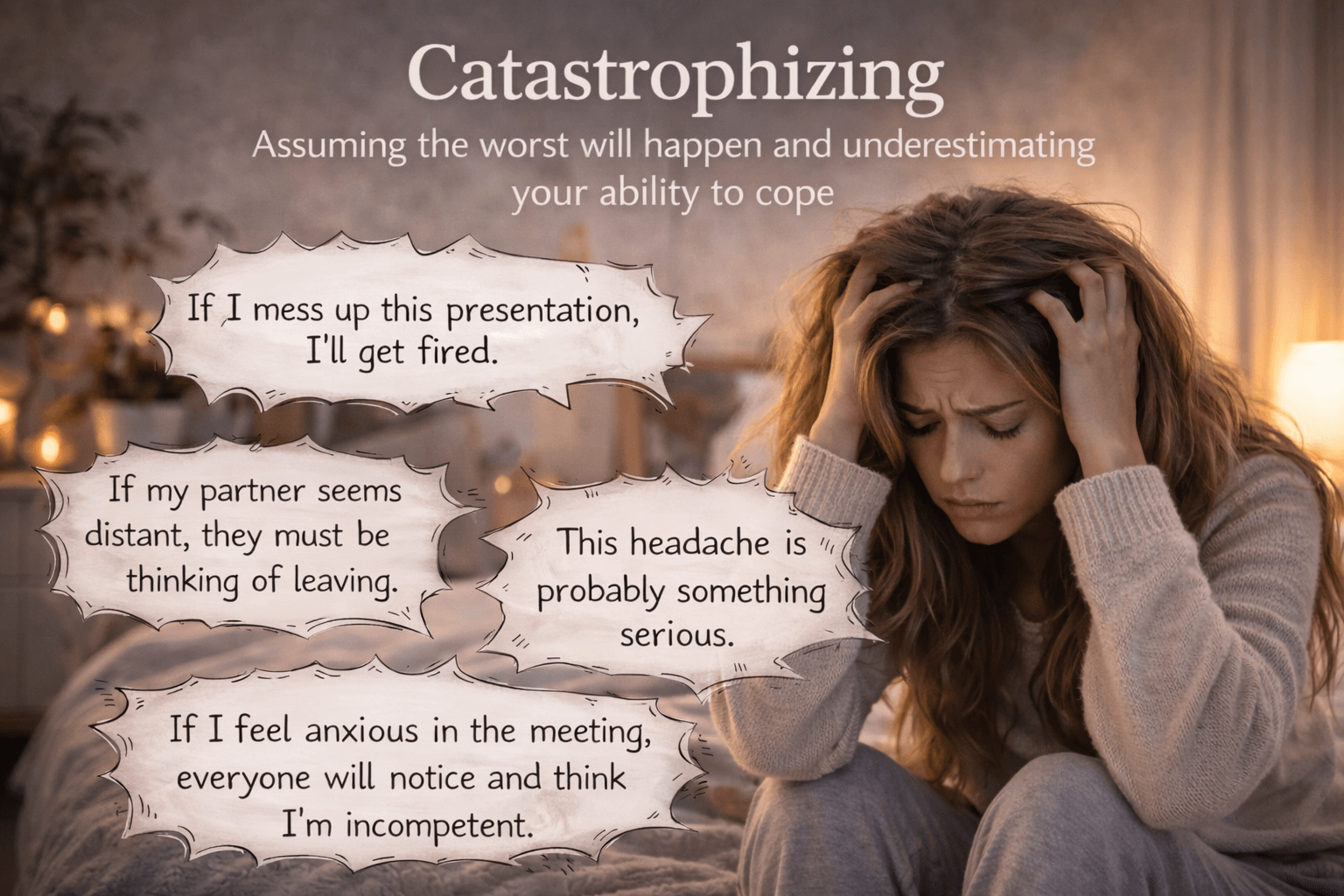
Catastrophizing is a cognitive distortion, a habitual and exaggerated way of interpreting events. It involves:
Assuming the worst will happen
Overestimating the likelihood of that outcome
Underestimating your ability to cope if it did
It often shows up in thoughts like:
“If I mess up this presentation, I’ll get fired.”
“If my partner seems distant, they must be thinking of leaving.”
“This headache is probably something serious.”
“If I feel anxious in the meeting, everyone will notice and think I’m incompetent.”
The key feature isn’t just imagining a negative outcome. That’s normal. It’s treating the negative outcome as inevitable and intolerable.
Why Does the Brain Catastrophize?
From an evolutionary standpoint, the brain is wired to detect threats. Our ancestors survived by anticipating danger. The problem is that the modern brain applies the same alarm system to social discomfort, performance pressure, and ambiguous situations.
Anxious brains are particularly sensitive to uncertainty. When there is a gap in information, the mind rushes to fill it. It often fills it with the most alarming explanation available.
Three psychological mechanisms fuel catastrophizing:
1. Intolerance of Uncertainty
Uncertainty feels unsafe. Catastrophic thinking gives the illusion of certainty, even if that certainty is negative.
2. Emotional Reasoning
“If I feel scared, something must be wrong.”
Anxiety is interpreted as evidence that danger is real.
3. Control Through Preparation
Some people believe that imagining the worst will prepare them. In reality, it often amplifies distress without increasing effective problem solving.
How Catastrophizing Maintains Anxiety
Catastrophizing doesn’t just reflect anxiety. It actively sustains it.
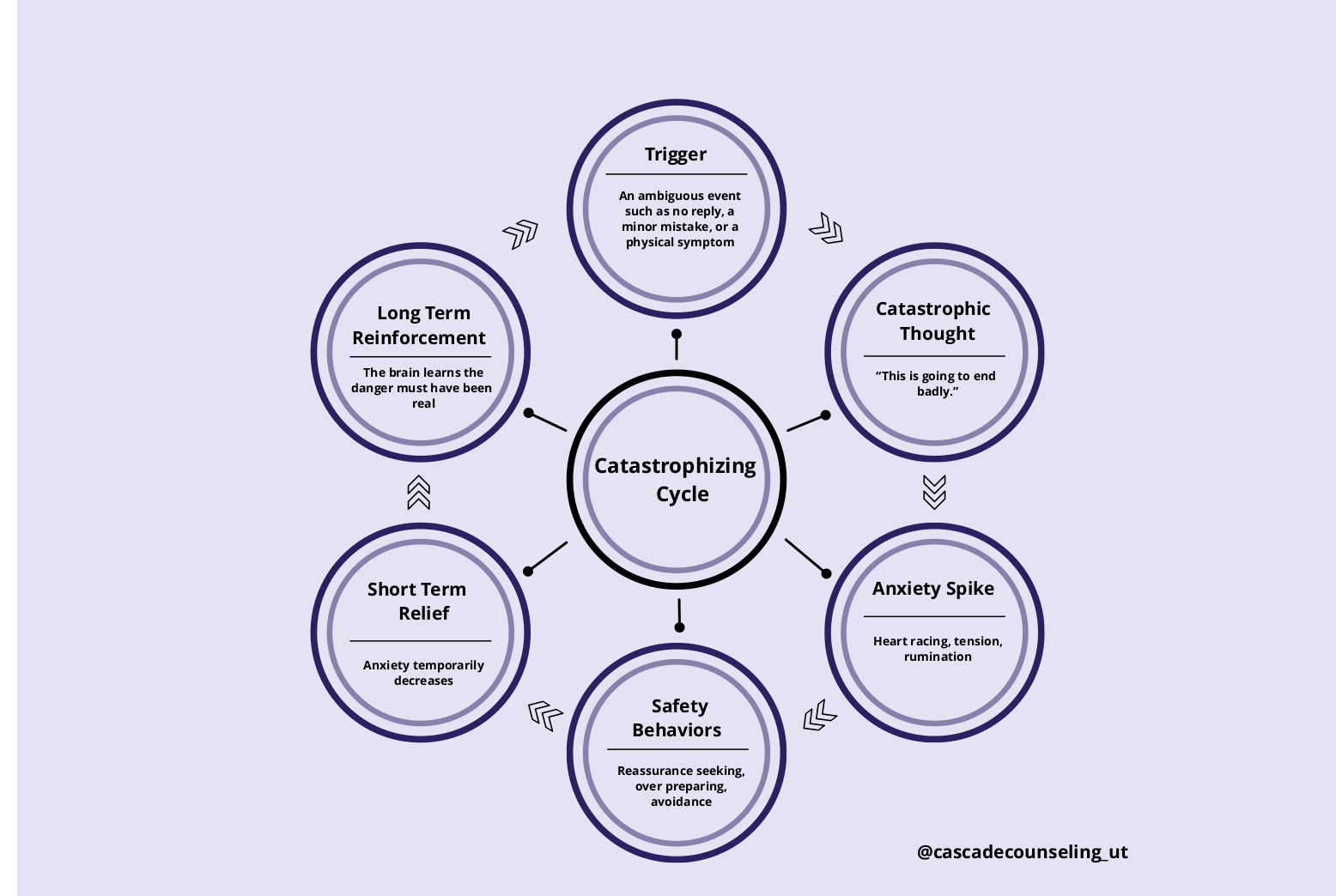
Here’s the cycle:
Trigger: An ambiguous event such as no reply, a minor mistake, or a physical symptom
Catastrophic Thought: “This is going to end badly.”
Anxiety Spike: Heart racing, tension, rumination
Safety Behaviors: Reassurance seeking, over preparing, avoidance
Short Term Relief: Anxiety temporarily decreases
Long Term Reinforcement: The brain learns the danger must have been real
Because safety behaviors reduce anxiety in the short term, they reinforce the catastrophic belief. The brain never gets to learn that the feared outcome was unlikely or manageable.
Common Themes of Catastrophizing
While catastrophizing can take many forms, it often centers around:
Rejection or abandonment
Failure or humiliation
Health concerns
Loss of control
Financial insecurity
Recognizing your personal catastrophe theme can be a powerful step. Many people notice their mind repeats the same core fear in different situations.
The Hidden Cost
Catastrophizing is exhausting.
It drains emotional energy, disrupts sleep, impairs concentration, and can strain relationships. It also narrows perspective. When the mind is locked onto worst case scenarios, it misses neutral or positive possibilities.
Perhaps most significantly, catastrophizing can erode confidence. If you constantly assume disaster, you subtly reinforce the belief that you are fragile or incapable.
How to Challenge Catastrophic Thinking
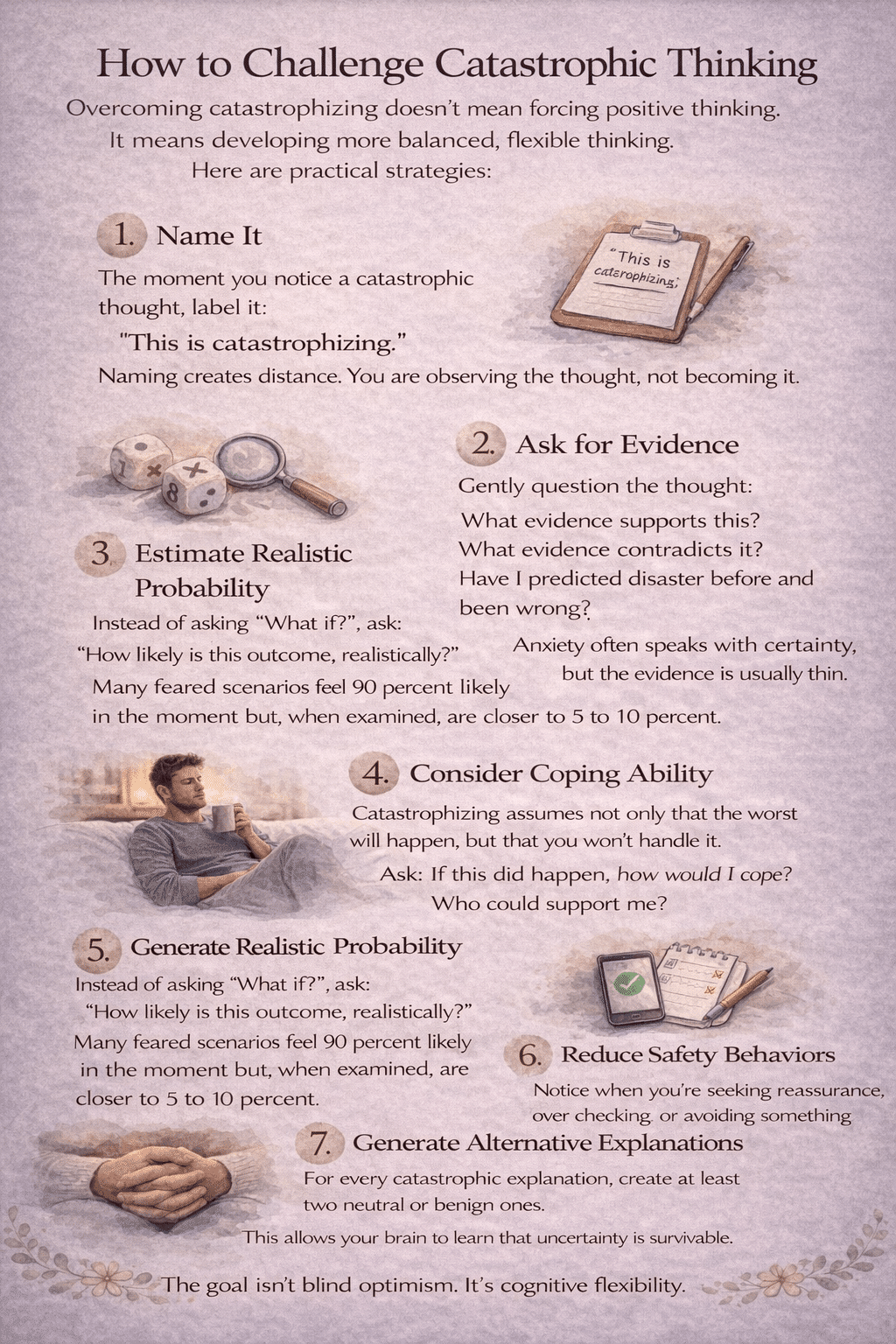
Overcoming catastrophizing doesn’t mean forcing positive thinking. It means developing more balanced, flexible thinking.
Here are practical strategies:
1. Name It
The moment you notice a catastrophic thought, label it:
“This is catastrophizing.”
Naming creates distance. You are observing the thought, not becoming it.
2. Ask for Evidence
Gently question the thought:
What evidence supports this?
What evidence contradicts it?
Have I predicted disaster before and been wrong?
Anxiety often speaks with certainty, but the evidence is usually thin.
3. Estimate Realistic Probability
Instead of asking “What if?”, ask:
“How likely is this outcome, realistically?”
Many feared scenarios feel 90 percent likely in the moment but, when examined, are closer to 5 to 10 percent.
4. Consider Coping Ability
Catastrophizing assumes not only that the worst will happen, but that you won’t handle it.
Ask:
If this did happen, how would I cope?
Who could support me?
Have I survived difficult things before?
Often, we underestimate our resilience.
5. Generate Alternative Explanations
For every catastrophic explanation, create at least two neutral or benign ones.
For example:
“They haven’t replied because they’re upset with me.”
Alternative: They’re busy.
Alternative: They forgot.
Alternative: They haven’t seen it.
The goal isn’t blind optimism. It’s cognitive flexibility.
6. Reduce Safety Behaviors
Notice when you’re seeking reassurance, over checking, or avoiding something out of fear. Gradually experiment with reducing these behaviors.
This allows your brain to learn that uncertainty is survivable.
7. Practice Tolerating Uncertainty
Instead of resolving every “what if,” practice sitting with uncertainty:
“I don’t know what will happen, and that’s okay.”
This is uncomfortable at first, but it builds psychological strength.
When Catastrophizing Feels Automatic
For many people, catastrophizing feels instant and involuntary. That’s normal. Cognitive patterns form over years.
The goal isn’t to eliminate catastrophic thoughts entirely. It’s to reduce how much you believe them and how much they control your behavior.
Think of it like building a new mental muscle. With repetition, balanced thinking becomes more accessible.
A Compassionate Perspective
It’s important to approach catastrophizing with compassion.
Your mind is not broken. It’s trying to protect you. The problem is that it’s overestimating danger and underestimating you.
Instead of fighting your anxiety harshly, try:
“My brain is trying to keep me safe. I can thank it and still choose a more balanced response.”
Self criticism tends to amplify anxiety. Self compassion softens it.
Final Thoughts
Catastrophizing is one of anxiety’s most persuasive tricks. It speaks loudly and urgently, convincing you that disaster is imminent.
But thoughts are not predictions.
By learning to notice catastrophic thinking, question it, and respond with balance rather than fear, you gradually retrain your brain. Over time, uncertainty becomes less threatening. Mistakes feel less catastrophic. Physical sensations feel less ominous.
And perhaps most importantly, you begin to trust your ability to cope, even if the worst were to happen.
Anxiety may always whisper, “What if?”
But you can learn to answer calmly and confidently:
“Maybe. But probably not. And I can handle it.”
If worst-case thinking has been running the show in your life, you don’t have to sort through it alone. Therapy can help you untangle anxious thought patterns and build steadier, more balanced responses. If you’re ready to take the next step, consider reaching out to Cascade Counseling to schedule a free 15-minute consultation and see if support feels like a good fit.