

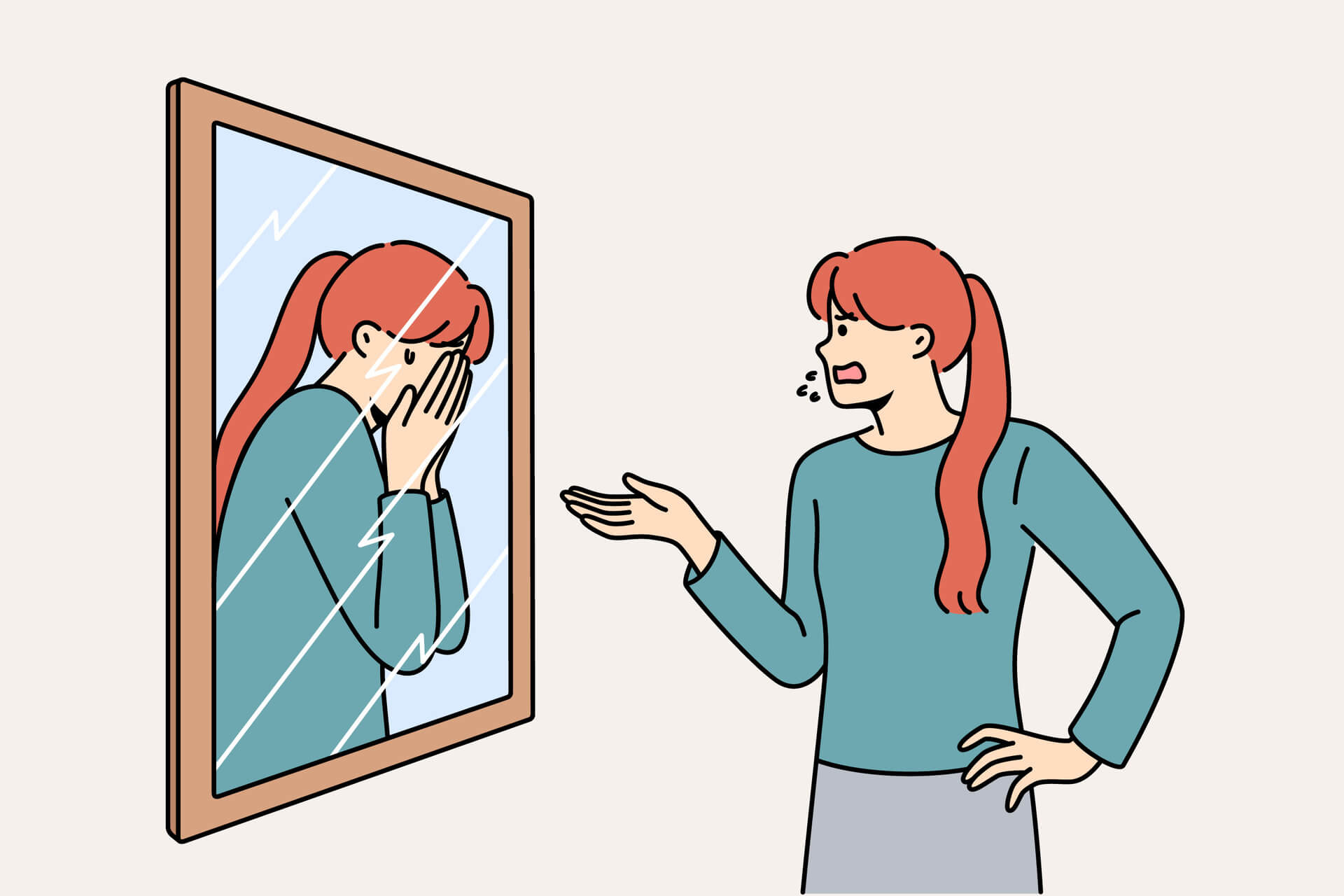
If you asked most people whether they would speak harshly to a struggling friend, they would almost certainly say no without hesitation. We pride ourselves on being supportive, encouraging, and compassionate toward the people we care about. And yet, when we turn inward, many of us become relentless critics.
We say things to ourselves we would never say out loud to another human being:
“What is wrong with me?”
“I should be better than this.”
“I always mess things up.”
“I’m not enough.”
For many, this inner dialogue is so automatic that it feels like truth rather than a learned pattern of thought. Over time, harsh self-talk erodes confidence, damages self-esteem, and leaves us feeling fundamentally unworthy. We become both the judge and the defendant in a courtroom that never adjourns.
The reality is this: we are often our own worst critics, not because criticism helps us grow, but because somewhere along the way we learned that being hard on ourselves was the path to improvement. But what if the opposite is true? Why do we assume that being critical of ourselves is what pushes us forward?
Why We Think Self-Criticism Helps
Many people believe self-criticism is motivating. We assume that if we push ourselves hard enough, shame ourselves enough, or highlight every flaw, we will improve.
Yet research consistently shows that self-criticism activates the brain’s threat system, the same stress response associated with danger. When we attack ourselves internally, our bodies interpret it as emotional threat. Cortisol rises. Anxiety increases. Creativity, resilience, and problem-solving decrease.
In other words, when we shame ourselves into change, we make change harder.
Self-compassion, on the other hand, activates the brain’s care and safety system. It allows us to acknowledge mistakes without becoming defined by them. It creates the emotional conditions necessary for growth and healthy emotional regulation.
What Self-Compassion Actually Is
Self-compassion is often misunderstood. Many worry it will make them lazy, complacent, or self-absorbed. But self-compassion is not about letting yourself off the hook. It is about how you hold yourself accountable.
Self-compassion includes three essential components:
1. Self-Kindness Instead of Self-Judgment
Rather than attacking yourself for struggling, you respond with understanding. You recognize that difficulty is part of being human, not evidence of failure.
2. Common Humanity Instead of Isolation
We often think, “It’s just me. Everyone else has it together.” Self-compassion reminds us that imperfection is universal. Struggle connects us; it does not separate us.
3. Mindfulness Instead of Over-Identification
Instead of drowning in negative thoughts, we learn to notice them without becoming consumed by them. We can say, “I am having a hard moment,” rather than, “My life is a mess.”
These three elements shift the relationship we have with ourselves from adversarial to supportive. That shift can change everything.
Self-Esteem Versus Self-Worth
Many people chase self-esteem, believing they must earn their worth through achievement, comparison, or perfection. But self-esteem built on performance is fragile. It rises when we succeed and collapses when we do not.
Self-compassion creates something far more stable: intrinsic self-worth.
When we practice self-compassion:
-
Confidence grows because we are no longer paralyzed by fear of failure.
-
Resilience increases because mistakes are seen as learning, not identity.
-
Motivation improves because we are driven by care, not shame.
-
Emotional safety allows us to take healthy risks.
-
We stop measuring our value against impossible standards.
Self-compassion provides the psychological soil in which genuine confidence can grow.
You cannot hate yourself into becoming someone you love. You can, however, support yourself into becoming someone you trust.

The Power of Inner Language
One of the most practical and overlooked ways to practice self-compassion is by changing how we speak to ourselves.
Our inner dialogue shapes our nervous system, our beliefs, and ultimately our sense of identity. If your mind is a place of constant criticism, your body lives in tension. If your mind becomes a place of encouragement, your body begins to feel safer.
Consider the difference between these two responses to making a mistake:
Harsh Inner Critic:
“I can’t believe I did that. I’m so stupid. I ruin everything.”
Self-Compassionate Voice:
“That didn’t go how I hoped. I’m disappointed, but mistakes happen. What can I learn from this?”
Both acknowledge the error. Only one allows growth.
Speaking kindly to yourself is not about pretending things are fine. It is about responding in a way that helps rather than harms.
The Culture of Pressure
We live in a culture that praises productivity, perfection, and comparison. From an early age, many of us internalize messages that our value depends on performance, appearance, or achievement.
We are taught to push harder.
Do more.
Be better.
Never fall behind.
Rarely are we taught how to respond to ourselves when we inevitably struggle. As a result, self-criticism becomes normalized and even worn as a badge of responsibility.
But constant internal pressure is not strength. It is exhaustion disguised as discipline.
Choosing self-compassion is not rejecting growth. It is rejecting unnecessary suffering.
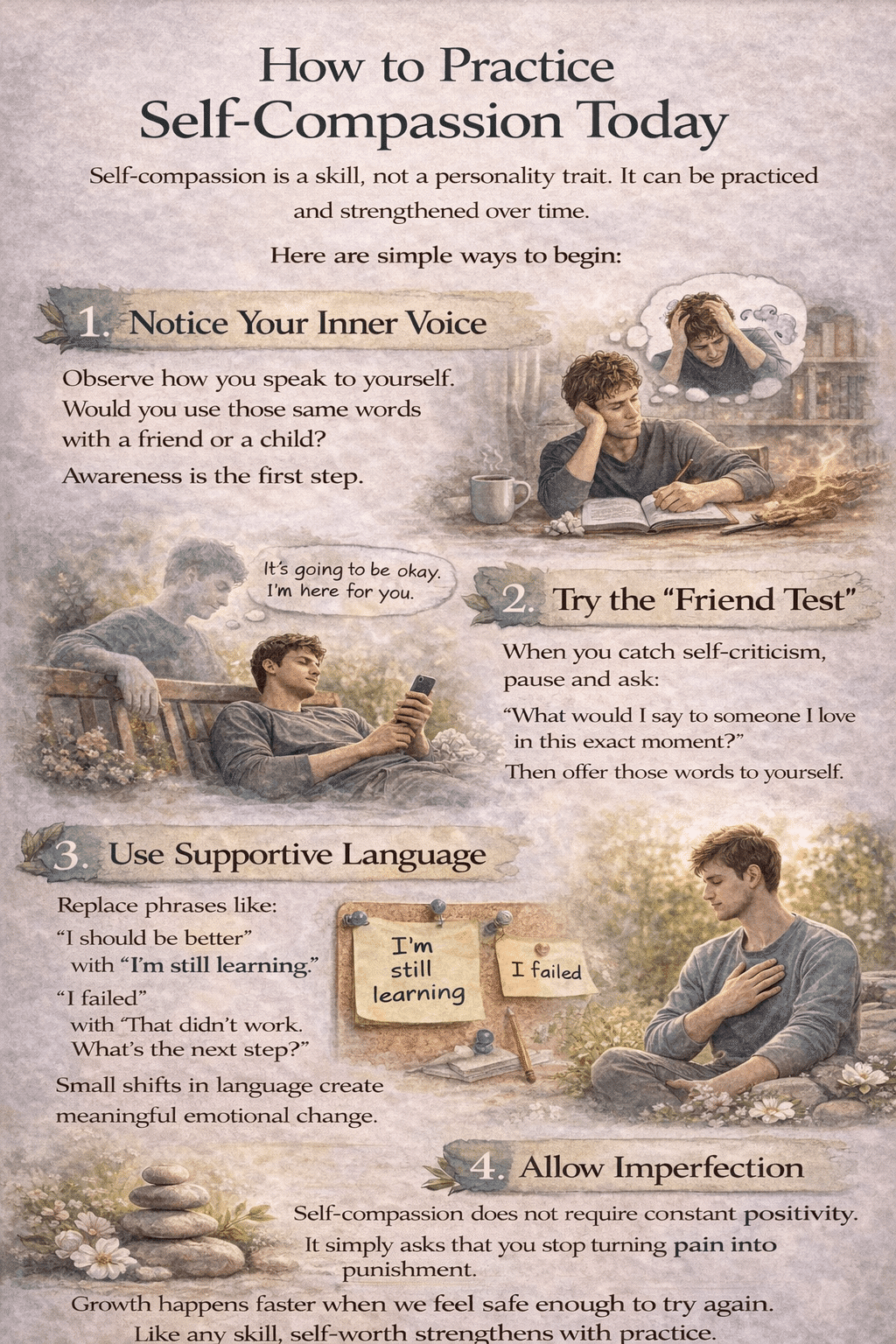
How to Practice Self-Compassion Today
Self-compassion is a skill, not a personality trait. It can be practiced and strengthened over time.
Here are simple ways to begin:
1. Notice Your Inner Voice
Observe how you speak to yourself. Would you use those same words with a friend or a child? Awareness is the first step.
2. Try the “Friend Test”
When you catch self-criticism, pause and ask:
“What would I say to someone I love in this exact moment?”
Then offer those words to yourself.
3. Use Supportive Language
Replace phrases like:
“I should be better” with “I’m still learning.”
“I failed” with “That didn’t work. What’s the next step?”
Small shifts in language create meaningful emotional change.
4. Allow Imperfection
Self-compassion does not require constant positivity. It simply asks that you stop turning pain into punishment.
Growth happens faster when we feel safe enough to try again. Like any skill, self-worth strengthens with practice.
Self-Worth Is a Relationship
Many of us spend years waiting to feel worthy:
When I achieve more.
When I look different.
When I stop making mistakes.
When I finally get everything right.
But self-worth is not a finish line. It is the relationship you build with yourself every day. Like any relationship, it is shaped by how you speak, how you respond to difficulty, and whether you offer understanding or judgment.
You are not more deserving of kindness when you are perfect. You are deserving of kindness because you are human.
The next time your inner critic begins to speak, pause. Take a breath. Answer with compassion. Not because you are ignoring your flaws, but because you are choosing to support your growth rather than sabotage it.
That is where real confidence begins. That is where real self-worth is built.
We Can Help
If you’ve been living with a harsh inner critic, you don’t have to keep navigating it alone. Therapy can help you untangle self-criticism, build self-compassion, and strengthen a more stable sense of self-worth.
At Cascade Counseling, we offer free 15-minute consultations so you can explore what support might look like for you. Whether you’re working through anxiety, low confidence, or long-standing patterns of self-doubt, we’re here to help.
You deserve a voice inside your head that supports your growth, not one that tears you down. Reach out today to take the first step.
This post draws on the research and framework of Kristin Neff, a leading scholar in the study of self-compassion.