
ADHD in Relationships: The Pursuer–Withdrawer Cycle

by | Apr 3, 2026

If you have ADHD, or are dating someone who does, you’ve probably noticed a pattern in your relationship that can feel frustrating, confusing, and even painful. One partner chases, while the other pulls away. Arguments feel endless, intimacy feels difficult, and no matter how much you care about each other, it can feel like you are not on the same page.

This pattern is known in couples therapy as the pursuer–withdrawer cycle, and ADHD can make it more intense. In this post, we’ll break down what this cycle looks like, why it happens, and how ADHD interacts with it. Most importantly, we’ll cover practical steps for breaking free so your relationship can feel safer, calmer, and more connected.

What Is the Pursuer–Withdrawer Cycle?

At its core, the pursuer–withdrawer cycle is a communication pattern that develops when emotional needs are not being met. Here’s how it typically works:

The Pursuer: This partner feels frustrated, disconnected, or unheard. They often try to fix the problem by talking, pushing for closeness, or asking for reassurance.

The Withdrawer: This partner feels pressured, overwhelmed, or criticized. They respond by pulling back, shutting down, or retreating into distraction.

The more the pursuer pushes, the more the withdrawer retreats. And the more the withdrawer retreats, the more the pursuer chases. This creates a negative feedback loop that can feel difficult to escape.

While this dynamic can happen in any relationship, it is especially common in couples where one or both partners have ADHD.
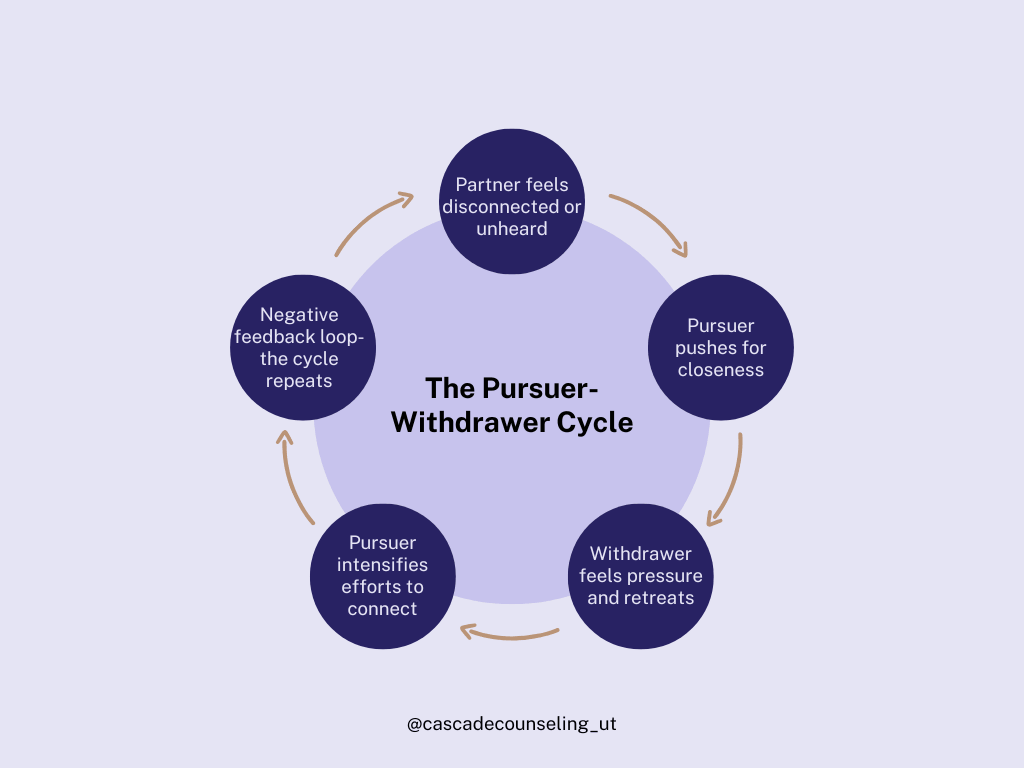
The pursuer-withdrawer cycle

Why ADHD Fuels the Cycle

ADHD impacts relationships in ways that are often subtle and misunderstood. Here are a few key ways it contributes:

Emotional Dysregulation

ADHD can make emotions feel more intense. Small frustrations can feel overwhelming, and moments of disconnection can feel much bigger than they are.

  • The pursuer may react from a place of strong emotional need, which can feel overwhelming to their partner.
  • The withdrawer may feel emotions just as strongly but struggle to regulate them, leading to shutdown instead of engagement.

This combination can quickly intensify the cycle.

Hyperfocus and Distractibility

ADHD can make it difficult to consistently notice or respond to a partner’s emotional cues.

  • The withdrawer may become deeply focused on work, hobbies, or other tasks, unintentionally neglecting the relationship.
  • The pursuer may interpret this as rejection, leading to increased attempts to reconnect.

Over time, both partners may begin to expect disappointment, which reinforces the cycle.

Miscommunication and Misinterpretation

Challenges with attention, memory, and executive functioning can create misunderstandings.

  • The pursuer may interpret forgetfulness or distraction as lack of care.
  • The withdrawer may feel criticized or overwhelmed by repeated requests for connection.

This mismatch often fuels frustration and disconnection.

Signs You May Be Stuck in the Cycle

It is not always obvious, especially when both partners care deeply. Some common signs include:

  • Arguments that start small but escalate quickly
  • One partner consistently chasing while the other shuts down
  • Feeling lonely or disconnected even when together
  • Avoiding difficult conversations to prevent conflict
  • Replaying arguments long after they end

If this sounds familiar, you are not alone. Many couples find themselves stuck in this pattern without realizing it.
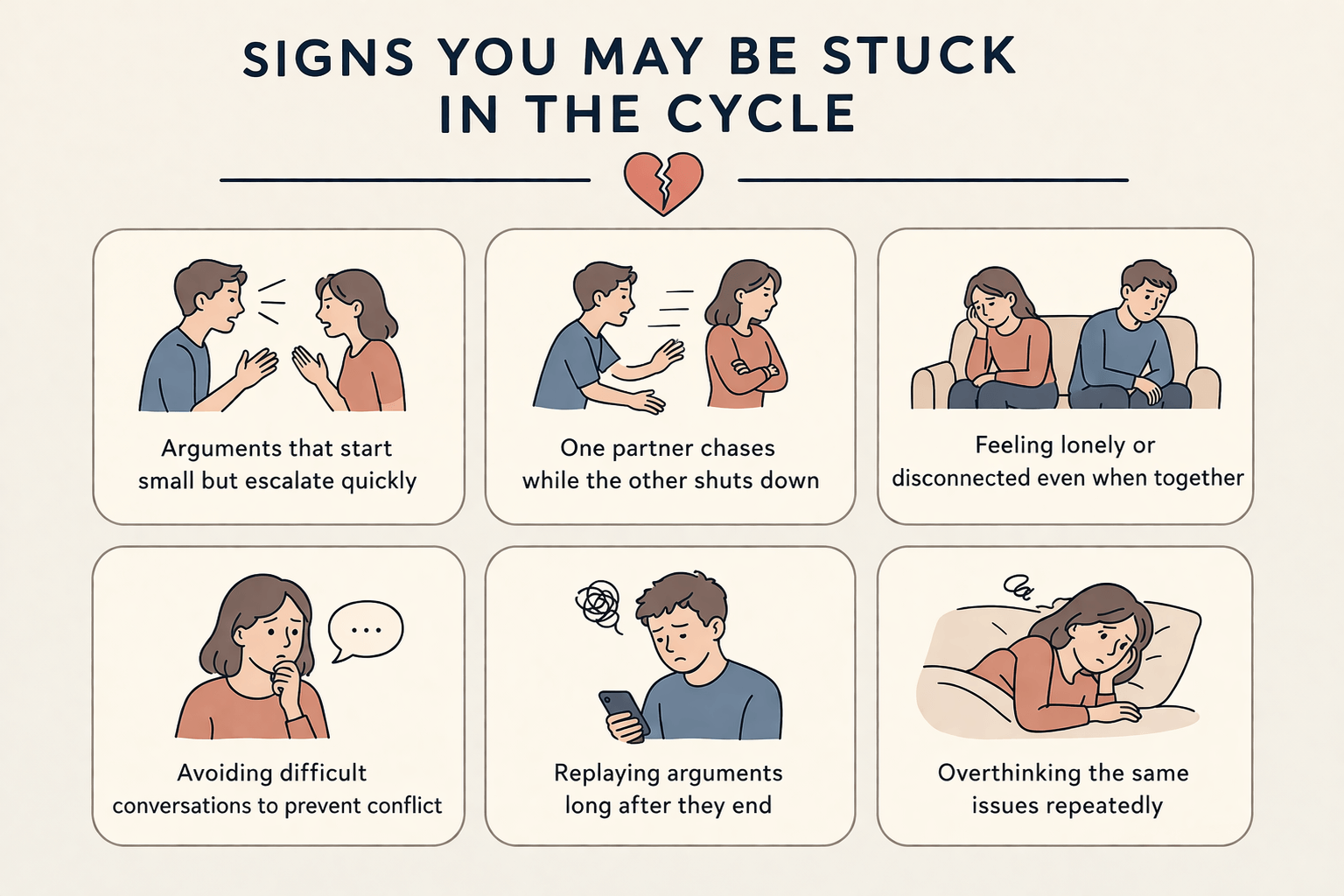
stuck in the cycle

The ADHD Twist: Why It Feels More Intense

ADHD can amplify the cycle in unique ways.

The Pursuer with ADHD:

  • May shift between intense focus on the relationship and distraction
  • Experiences strong emotional highs and lows, making conflict feel urgent
  • May struggle to self-soothe, increasing chasing behaviors

The Withdrawer with ADHD:

  • May need space to regulate but is perceived as rejecting
  • May forget commitments, unintentionally escalating conflict
  • May avoid conflict due to anxiety, deepening withdrawal

Whether ADHD shows up more in one partner or both, the result is often increased intensity and emotional exhaustion.

Breaking the Cycle

The good news is that this cycle can be understood and changed. It begins with awareness and small, consistent shifts.

Recognize Your Role

Start by identifying your pattern.

  • Am I chasing or withdrawing?
  • What emotions are underneath my behavior?
  • How might ADHD be influencing my responses?

Awareness creates space for change.

Pause Before Reacting

ADHD can increase impulsive reactions, especially during conflict.

  • Take a breath before responding
  • Ask for a pause if needed
  • Return to the conversation once emotions settle

Even a short pause can interrupt the cycle.

Use Clear Communication

Clarity helps reduce misunderstanding.

  • Replace “You never listen” with “I felt unheard when that happened”
  • Focus on your experience rather than your partner’s intent

This reduces defensiveness and increases understanding.

Build Connection Outside of Conflict

Connection should not only happen after conflict.

  • Schedule time together
  • Celebrate small moments
  • Check in regularly without trying to fix anything

These moments strengthen the relationship and reduce the need for chasing.

Practice Self-Regulation

Self-regulation is essential, especially with ADHD.

  • Take movement breaks
  • Practice simple breathing or grounding
  • Write down thoughts before responding

As regulation improves, the cycle loses intensity.

Consider Therapy

Support can make a meaningful difference.

  • Couples therapy helps both partners understand the cycle
  • Individual therapy builds regulation and awareness
  • ADHD coaching provides practical tools for daily challenges

couple attending therapy together

ADHD and Empathy

Empathy is one of the most powerful ways to shift this pattern.

  • The pursuer can begin to see that withdrawal is often a form of overwhelm, not rejection.
  • The withdrawer can begin to see that pursuit is often a desire for connection, not criticism.

When you move from blame to understanding, the dynamic begins to change. You stop fighting each other and start responding to what each person actually needs.

Final Thoughts

ADHD in relationships can make the pursuer–withdrawer cycle feel more intense, confusing, and exhausting. But understanding the pattern, and how ADHD influences it, is the first step toward change.

With awareness, patience, and consistent effort, couples can begin to shift this dynamic. Small changes in communication, regulation, and connection can make a meaningful difference over time.

This is not about blame. It is about understanding.

ADHD is not a flaw. It is a different way of processing emotion, attention, and connection. When couples learn how to work with it instead of against it, relationships can become more supportive, more connected, and more resilient.

Therapy Can Help

If you recognize this pattern in your relationship, you are not alone. Many couples experience this cycle, especially when ADHD is part of the dynamic.

At Cascade Counseling, we help individuals and couples understand these patterns and build healthier ways of connecting. We offer free 15-minute consultations so you can explore whether therapy feels like a good fit. Reach out today to take the next step toward a more connected and supportive relationship.

Need Extra Resources & Tips

Check out our resources page, filled with FAQ’s and book recommendations.

Hand outside in the rain CTA

What others are saying

EXCELLENT
Google star 1Google star 2Google star 3Google star 4Google star 5
Based on 44 reviews
Posted on Google Google
Sam profile picture
Sam
Google star 1Google star 2Google star 3Google star 4Google star 5Trustindex verifies that the original source of the review is Google.
I have gone through multiple therapist trying to find the right one. I finally found a fantastic one, which is KAT! Go see her. She is incredible.
Posted on Google Google
Brielle Chigbu profile picture
Brielle Chigbu
Google star 1Google star 2Google star 3Google star 4Google star 5Trustindex verifies that the original source of the review is Google.
Jen has helped me so much. I have loved IFS and diving deeper into my different parts. She has so many great tools in her tool belt and is a great listener. I could not recommend a better therapist than her for my needs!
Posted on Google Google
Aimree profile picture
Aimree
Google star 1Google star 2Google star 3Google star 4Google star 5Trustindex verifies that the original source of the review is Google.
I've taken therapy from Sarah for three years and she's amazing! I'm so thankful for her patience and dedication and I highly recommend her!!
Posted on Google Google
Scott Christensen profile picture
Scott Christensen
Google star 1Google star 2Google star 3Google star 4Google star 5Trustindex verifies that the original source of the review is Google.
Jen is awesome!!!
Posted on Google Google
Alex Thomas profile picture
Alex Thomas
Google star 1Google star 2Google star 3Google star 4Google star 5Trustindex verifies that the original source of the review is Google.
Cascade Counseling is a safe and comfortable space for anyone seeking therapy! I know the owner personally and can guarantee that the most important aspect of their daily operations is patient care. I am extremely thankful to know I have a place to go where I will be well taken care of!
Posted on Google Google
O o profile picture
O o
Google star 1Google star 2Google star 3Google star 4Google star 5Trustindex verifies that the original source of the review is Google.
Really relaxing and well thought out. The entrance is a little difficult, but manageable.
Posted on Google Google
Rachel Taylor profile picture
Rachel Taylor
Google star 1Google star 2Google star 3Google star 4Google star 5Trustindex verifies that the original source of the review is Google.
I'd been through 4-5 therapists without finding the right fit, when I finally met Joel. It honestly felt like winning the lottery! He truly listened, offered practical tools, and helped me through some of the darkest seasons of my life. I’d recommend Cascade Counseling to anyone looking for a caring, compassionate therapist.
Posted on Google Google
Travis Carter profile picture
Travis Carter
Google star 1Google star 2Google star 3Google star 4Google star 5Trustindex verifies that the original source of the review is Google.
Very professional and punctual but flexible at the same time. Sessions feel personal and hopeful. Joel is really good about being aware of your goals and aspirations and will help you find them. He can relate to a younger generation like myself with his age and style. He also has gone through a lot in order to understand others.
Posted on Google Google
Bobby Shaw profile picture
Bobby Shaw
Google star 1Google star 2Google star 3Google star 4Google star 5Trustindex verifies that the original source of the review is Google.
This place is amazing. I would love to comment more about Kat I got the pleasure to work with her when she was a psych tech at Ascend Recovery. I always knew she was meant to do bigger and better things. She’s now a counselor at “Cascade Counseling” so proud of her. I trust her full heartedly with my own child. Cascade Counseling is the place to go!!!
Verified by Trustindex
Trustindex verified badge is the Universal Symbol of Trust. Only the greatest companies can get the verified badge who has a review score above 4.5, based on customer reviews over the past 12 months. Read more

Recent Articles

Contact Us For More!

We’re here to help you transform your life!

Ready to take the next step toward healing? Our therapists are here to help you feel seen, supported, and empowered.

Contact Us