
People with OCD often describe a familiar, frustrating moment:
“Why am I feeling this way?”
“What’s wrong with me for having this emotion?”
“If I could just stop feeling this, the thoughts would calm down.”
OCD has a way of convincing you that the emotion itself is the problem. That anxiety, guilt, hurt, irritation, anger, or sadness is the threat that needs to be eliminated.
But here is the truth:
Your emotions are not the problem.
They are logical, appropriate, and trying to communicate something real.
It is the behavioral response, the compulsion, that turns a normal emotion into a distressing cycle.
OCD steps in like an overeager translator who hears your emotion perfectly and still gives you the wrong answer.
OCD Is Not Caused by “Wrong” Emotions. It Is Caused by a Misinterpretation.
Every emotion you experience has a purpose:
Anxiety says, “Prepare.”
Guilt says, “Repair something.”
Hurt says, “Heal.”
Anger or irritation says, “Draw boundaries.”
Sadness says, “Connect.”
These emotional cues are healthy. They are functioning exactly as they should.
In OCD, the emotion is not the issue. The issue is that OCD misreads it and sends you into action that does not match what the emotion actually needs.
The emotion is speaking clearly. OCD responds as if it heard something entirely different.
OCD Gives You an Answer to a Question You Didn’t Ask
Imagine experiencing:
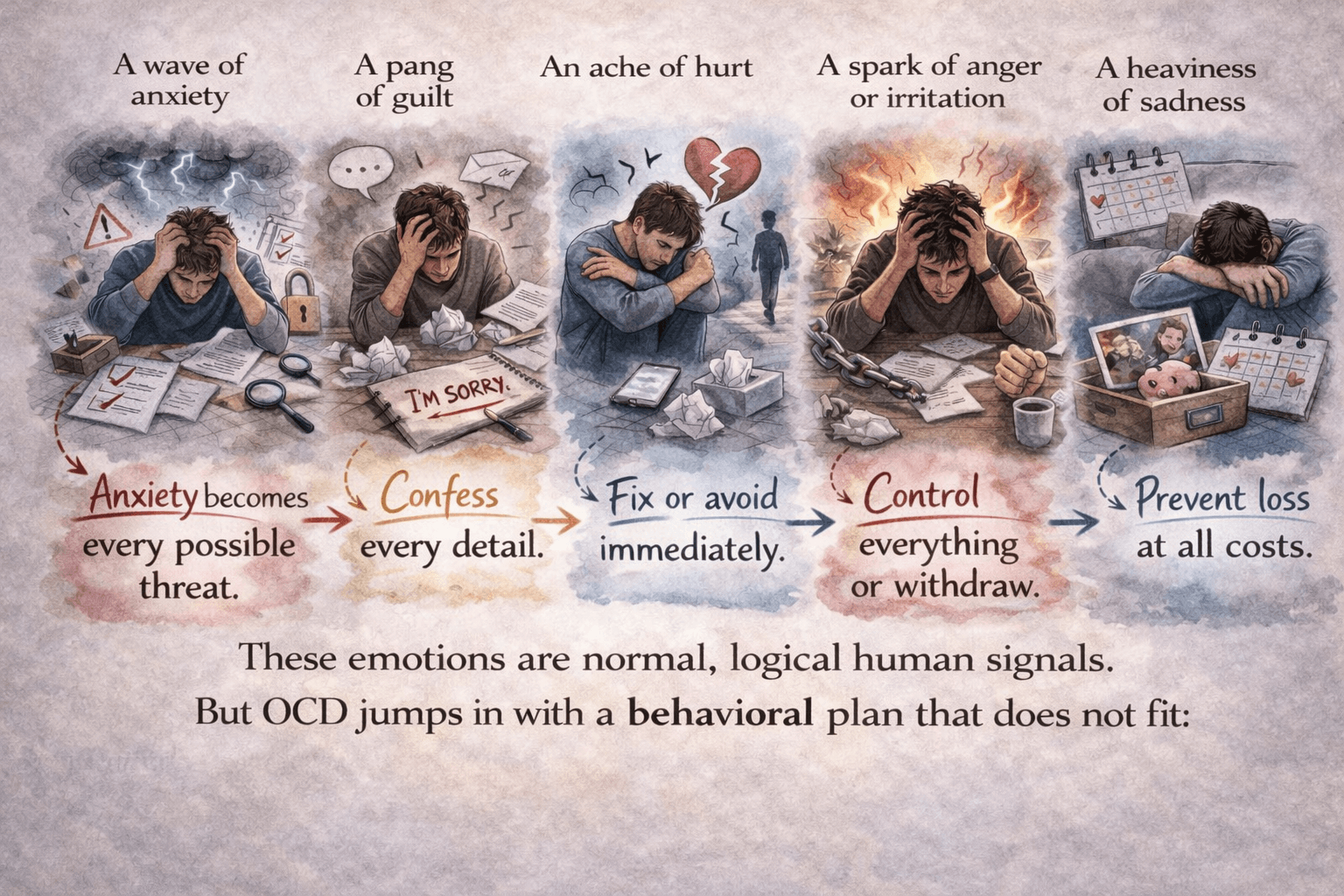
A wave of anxiety
A pang of guilt
An ache of hurt
A spark of anger or irritation
A heaviness of sadness
These emotions are normal, logical human signals.
But OCD jumps in with a behavioral plan that does not fit:
Anxiety becomes “Eliminate every possible threat.”
Guilt becomes “Confess every detail.”
Hurt becomes “Fix or avoid immediately.”
Anger or irritation becomes “Control everything or withdraw.”
Sadness becomes “Prevent loss at all costs.”
It is not that the emotion is too strong. It is that the compulsion is answering the wrong emotional request.
Why Compulsions Make the Emotion Louder
Here is how the OCD cycle builds:
You feel a real, purposeful emotion.
You respond with a compulsion instead of the appropriate action.
The emotion goes unheard and unaddressed.
So it intensifies to get your attention.
OCD interprets the louder emotion as danger.
More compulsions follow, still the wrong response.
And the cycle continues.
Your emotion is not faulty. It is repeating itself because you have not been allowed to respond to it properly.
If you said, “I’m hurt and need healing,” and the response you got was, “Better count all the appliances,” you would try again. Louder.
The Solution Is Not Eliminating Emotion. It Is Responding Accurately.
Healing OCD is not about numbing your emotions or shutting them down.
It is about correcting the mismatch between emotion and behavior:
Anxiety wants preparation, not compulsive prevention.
Guilt wants repair, not ritualistic confession.
Hurt wants healing, not reassurance loops.
Anger or irritation wants boundaries, not control.
Sadness wants connection, not avoidance.
These responses are simple, human, and appropriate. They are the right answers to the emotions you are already experiencing.
Your emotion is only loud because it keeps getting the wrong response.
OCD Is Not a Monster. It Is a Miscommunication.
Seeing OCD clearly changes the emotional landscape.
You stop fearing your own feelings.
You stop assuming something is wrong with you.
You stop viewing OCD as a catastrophic condition.
Because OCD is ultimately a behavioral misinterpretation of your emotional cues.
Persistent? Yes.
Confusing? Absolutely.
Unfixable? No.
If You Have OCD, Here Is What We Want You to Know
Your emotions make sense. They are working exactly as they should.
The thoughts and compulsions are not protecting you. They are interrupting you.
When you begin answering your emotions yourself, even in small ways, something important shifts:
Your emotions feel calmer.
Compulsions lose urgency.
You regain trust in your own internal signals.
Your emotions have been right all along.
They just needed your response, not OCD’s.
Cascade Counseling is Here for You
If you’re noticing OCD patterns in your life, you don’t have to sort through them alone. Therapy can help you understand what your emotions are really asking for and build tools that interrupt the cycle without fighting yourself. We offer free 15 minute consultations, reach out today to find the best fit for you.