

Your doctor signed the form. Your physical therapist says the strength numbers look good. Your coach is glad to have you back. On paper, you’re ready.
Then you step into your first full-speed drill, and something in you hesitates. You plant a little softer. You avoid the cut you used to make without thinking. When a defender comes at you, your eyes go straight to the knee, the shoulder, the ankle that got hurt.
Nobody else seems to notice, but you do. And it can be confusing, because the injury is supposed to be over. If that sounds familiar, you’re dealing with one of the most common parts of coming back that almost nobody talks about: fear of reinjury.
Key Takeaways
Fear of reinjury is the worry, tension, or hesitation an athlete feels about getting hurt again, often showing up even after a doctor and physical therapist have cleared them to play.
- It’s a common response to injury, and it can appear even when your strength and range-of-motion numbers look good.
- Pushing through it and avoiding the movements that scare you can both keep it going. Small, planned steps give your brain better evidence.
- It often rises again just before you return to sport, so feeling steady in rehab and shaky at clearance is normal.
- Your physical therapist and a sport counselor can work from the same plan. Extra support makes sense if you’ve been cleared for a while and still can’t play freely.
Cleared Isn’t the Same as Ready
Physical recovery and mental recovery run on different clocks. Rehab measures things that can be tested: range of motion, strength, balance, how far you can run without pain. Those numbers tell your medical team when the tissue has healed.
What they can’t measure is trust. Your brain was there when you got hurt. It remembers the pop, the pain, the walk off the field, and the months that followed. From your brain’s point of view, that movement is now linked with danger. Its job is to protect you, so it puts on the brakes, even when your body no longer needs it to.
Researchers sometimes call this kinesiophobia, a fear of movement after pain or injury. You don’t need the technical term to know the feeling. It’s the voice that says “not yet” when your body is saying “go.”
Fear of Reinjury, Reinjury Anxiety, and Kinesiophobia: What’s the Difference?
You’ll see three terms in sports medicine, and they overlap. Fear of reinjury is fear aimed at the injury itself, like the knee giving way. Reinjury anxiety is more about worry over what another injury would cost you: more surgery, more months of rehab, a lost season. Kinesiophobia is the broader fear of movement. Athletes often feel more than one at once, and researchers still debate where the lines fall. You don’t need to pick the right label. What helps is noticing what your fear is actually about, because that shows you where to start.
This is why some athletes stall late in rehab, after most of the hard physical work is done. The body caught up. The confidence hasn’t yet.
What the research shows. A 2017 clinical review in Sports Health (Hsu and colleagues) summarized a meta-analysis of athletes after ACL reconstruction. Only 63% returned to their pre-injury level of play, and fear of reinjury was the reason cited most often for playing less, even though more than 85% had satisfactory results on knee laxity, strength, and hop tests. Read the review.
How Fear of Reinjury Shows Up
On the field, it rarely looks like fear. It looks like playing a half-step slow. A soccer player shields the leg that was hurt and stops going in hard for tackles. A pitcher who had elbow surgery holds back on the fastball without meaning to. A gymnast hesitates at the exact point in the routine where the fall happened. Coaches might read it as rust or lack of effort, which can add pressure on top of the fear.
In the body, it can feel like tight muscles around the injured area, a racing heart before certain drills, or an extra jolt of alarm at every small twinge. Normal soreness starts to feel like a warning sign.
In your head, it often sounds like constant scanning. You check how the knee feels after every rep. You replay the injury before you fall asleep. You picture it happening again, sometimes in vivid detail.
And off the field, it can spill into the rest of life. Some athletes start avoiding pickup games, stairs taken two at a time, or anything that feels like a risk. Others feel a low hum of worry that follows them into class or work. That’s when it starts to look less like a sports problem and more like anxiety, which is worth paying attention to.
When Fear of Reinjury Tends to Show Up
Many athletes expect the fear to be loudest right after the injury and then fade as rehab goes well. For a lot of people that’s only half the story. Research on how athletes respond to injury describes a U-shaped pattern: distress is highest early, eases during rehab, and then often rises again as the return to sport gets close. If you felt steady for months and the nerves arrived the week you were cleared, that timing is common.
Pain usually isn’t the cause. By the time athletes return, pain is often low, so hesitation at this stage tends to come from what the movement means to you, not from what the joint is reporting. Researchers also note that physical readiness and psychological readiness to return to sport don’t always arrive together. A clean test result and a confident body can show up weeks apart.
Why Pushing Through and Holding Back Both Backfire
Most athletes respond to this fear in one of two ways, and both make sense.
The first is to ignore it. Sport culture teaches you to be tough, so you tell yourself to stop being soft and just go. The trouble is that fear doesn’t disappear because you told it to. It tends to go underground and show up as tension, which changes how you move. A guarded body is a stiffer body, and moving stiffly can make you feel even less safe.
The second is to avoid the scary movements. You stay in the drills that feel fine and quietly skip the ones that don’t. That brings relief in the moment, but every time you avoid something, your brain takes it as proof that the thing really was dangerous. The fear grows a little each time.
There’s a third option between those two. It means taking the fear seriously without letting it run the show, and rebuilding trust in steps that are challenging but doable.
Rebuilding Trust, One Rep at a Time
Trust comes back the same way strength did: gradually, with the right amount of challenge. That usually starts with getting specific. “Playing scares me” is hard to work with. “I tense up when I land on my left leg after a rebound” gives you something to practice. Many athletes find it helpful to rank the movements that worry them, from mildly uncomfortable to truly scary, and work up from the bottom.
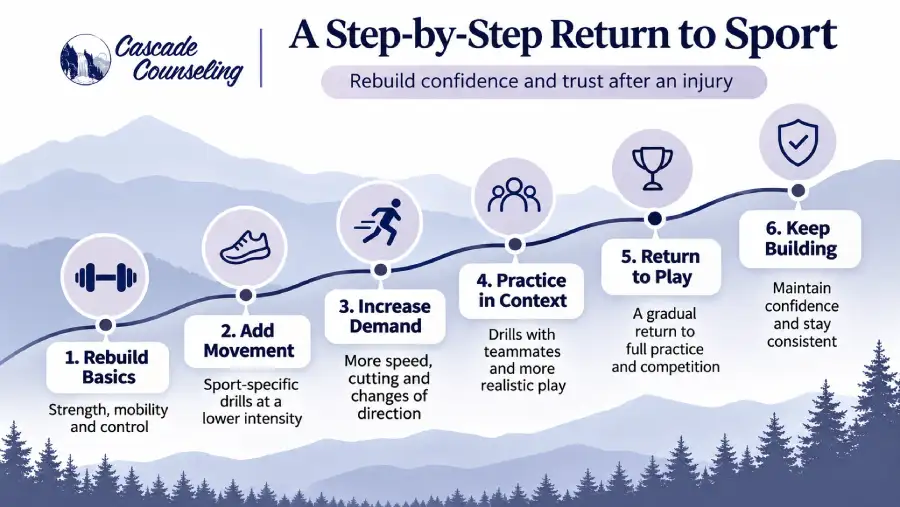
What a Step-by-Step Return Can Look Like
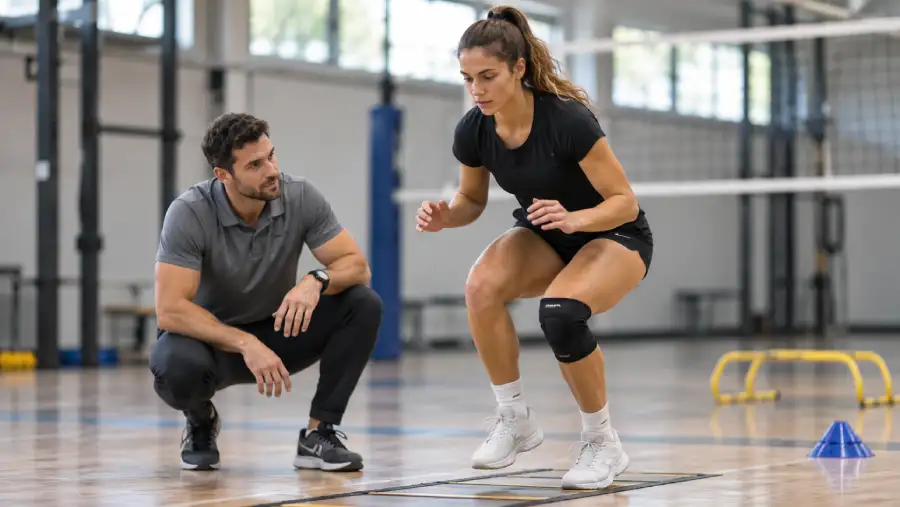
Here’s an illustration for a volleyball player whose left ankle was sprained on a landing. The movement that scares her most is landing from a block, so her list might run from easiest to hardest like this:
- Two-footed hops in warm-up, with no ball.
- Landing from a spike approach at half effort in a drill.
- Landing on the left foot only, still in a drill.
- Blocking against a teammate in a controlled drill.
- Blocking in a scrimmage.
- Blocking in a match.
She stays on each step until the fear drops to a level she can work with, then moves up. The goal isn’t zero fear. It’s staying with the step long enough for her brain to collect proof that the landing went fine. Clinicians call this graded exposure, and your physical therapist should be part of it, since they know what each step asks of the joint. Share your own list with them. If one step stays stuck, that’s useful information too, and a good moment to bring in extra support.
Each step is a chance for your brain to collect new evidence. You land the jump, and nothing bad happens. You do it again the next day, and again. Over time, the old link between that movement and danger gets weaker, and a new one forms. This process takes repetition, and some days will feel like a step back. That’s part of it, not a sign you’re failing.
It also helps to change what you pay attention to. When fear is high, attention locks onto the injury. Shifting focus to the task, like the ball, your teammate, or where you want to go, gives your body permission to move more naturally. Some athletes also use mental rehearsal to practice a movement before they try it for real; our post on mastering visualization explains how that works.
None of this replaces your physical therapist. Your PT knows what your body is ready for, and the mental side works best when it follows their plan. Think of it as two people on the same rehab team: one rebuilding the joint, the other helping you trust it.
Soreness, Pain, and Fear: How to Tell What You’re Feeling
After an injury, every twinge can feel like an alarm. That makes sense: your brain learned that a certain sensation came right before something went wrong. The difficulty is that ordinary training soreness, a sign that needs attention, and fear-driven tension can feel alike, especially early on. Cleveland Clinic’s Dr. Matthew Sacco has described how hard it is to tell helpful soreness from harmful pain, so athletes may react to all of it as if it were serious. Read his full interview.
Fear adds to the picture. When your body is on alert, muscles tighten, and tight muscles can make normal sensations feel louder.
One simple step helps. Before you return to full practice, ask your physical therapist or doctor to describe, in plain terms, what normal soreness should feel like for your injury and what would mean you should stop and call. Write it down. Then when a twinge shows up, you’re comparing it to a list you trust instead of to your worst-case replay. Anything on the “call” list gets reported. Anything on the “expected” list gets noted, and you keep going.
The Part of Rehab Nobody Schedules
Fear is rarely the only feeling in the room. Long recoveries tend to bring frustration with slow progress, jealousy watching someone else take your spot, and loneliness when the team travels without you. Some athletes feel guilty for being sad about “just” an injury when other people have bigger problems.
There’s also a quieter question that can come up during time away: who am I when I’m not playing? For athletes whose whole identity is wrapped up in their sport, months on the sideline can shake their sense of self as much as their confidence.
These feelings deserve attention, too. Athletes who make room for them often find the fear easier to work with, because they’re no longer carrying everything at once. Talking with someone, whether that’s a teammate who’s been through it, a parent, or a counselor, can take some of that weight off.
How Parents and Coaches Can Help
If you’re a parent or coach, hesitation can look like lost effort, and the pull to say “just go for it” is strong. It rarely helps. A few things land better.
Ask instead of assuming. “What part of that felt hardest?” opens a conversation that “Why are you playing so timid?” shuts down. Treat early practices as part of rehab, not a test. Praise the step the athlete took, like the first hard cut, instead of the result. And keep your messages in line with the physical therapist’s plan so the athlete isn’t hearing two different answers about what they’re ready for.
Notice what happens off the field, too. If an athlete stops enjoying the sport, sleeps poorly, or pulls away from teammates, the injury may be carrying more than fear. That’s a good time to suggest a conversation with a counselor, offered as an option and not as a verdict.
When to Get Support
Some nerves after an injury are normal and fade with a few weeks of solid practice. It may be time for extra help if you’ve been cleared for a while and still can’t play freely, if the fear is getting stronger instead of weaker, or if it’s affecting your sleep, mood, or life outside of sport. The same goes if you’re thinking about quitting mainly because the fear feels too big to face.
At our Provo office, our sport and performance psychology counseling helps athletes work through the mental side of coming back. Sessions can include building a step-by-step plan for the movements that feel scary, practicing focus and self-talk for the first full-speed practices, and making space for the frustration or low mood that often comes with a long recovery. We’re happy to work alongside your physical therapist so everyone is pulling in the same direction.

We work with high school, club, college, and adult athletes across Utah County. We can’t promise a timeline, because every comeback is different. What we can offer is a clear plan and a place to work through the fear instead of fighting it alone.
Fear of Reinjury: Common Questions
What is fear of reinjury?
Fear of reinjury is the worry or hesitation an athlete feels about getting hurt again after an injury, even when they’ve been medically cleared. It can show up as playing a half-step slower, avoiding certain movements, tension around the injured area, or constantly checking how the joint feels.
Is it normal to be afraid of reinjury after being cleared to play?
Yes. A clinical review in Sports Health describes fear of reinjury as a common response to sports injury, and it often rises again as the return to sport gets close. Feeling it says nothing bad about your recovery or your toughness.
How long does fear of reinjury last?
There’s no reliable timeline, because it varies from person to person. Mild nerves often settle within a few weeks of steady practice. If you’ve been cleared for a while and the fear is staying the same or getting stronger, extra support is worth considering.
Can fear of reinjury make me more likely to get hurt again?
It may. The same clinical review notes that fear of reinjury can change how muscles are recruited, which has been linked with a higher chance of actual reinjury. Guarded, stiff movement is one reason it’s worth working on the fear instead of hiding it.
Do I need a sport counselor, or can my physical therapist handle it?
Your physical therapist guides the joint and the physical progression. A sport and performance psychology counselor works on the mental side: focus, self-talk, a step-by-step plan for scary movements, and the frustration or low mood that can come with a long recovery. Many athletes use both, and the two can work from the same plan.
What helps with fear of reinjury?
Gradual exposure to the movements that worry you, paired with mental skills like goal setting, imagery, self-talk, and relaxation, is the usual approach. A clinical review also lists education about the injury and social support. Which tools fit depends on what your fear is actually about.
Final Thoughts
Fear of reinjury isn’t a weakness or a sign you’re not tough enough. It’s your brain trying to protect you after something painful happened. The goal isn’t to never feel it again. It’s to feel it, understand it, and keep moving anyway, until your body and your mind are back on the same page.
You already did the hard work of healing. Learning to trust that healing is the last part of the comeback, and it’s a part you can train.