
The last whistle blows. Maybe it’s your senior night, the final game of your college career, or a Tuesday practice where your knee gives out and the season ends in a second. You walk off the field, take off your shoes, and drive home.
Then the next morning comes. There’s no practice to get to. No lift, no film, no group chat buzzing about the next game. You have more free time than you’ve had in years, and somehow it feels awful.
If you’ve felt lost after your sport ended or was taken away, you’re not being dramatic. You’re running into something real, and it has a name: athletic identity.
Key Takeaways
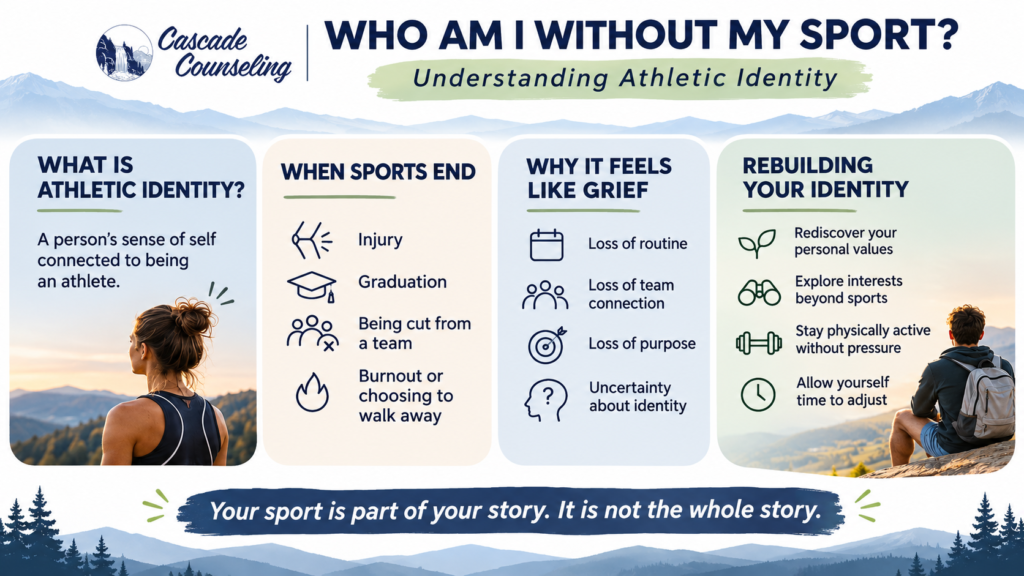
- Athletic identity is how much you see yourself as an athlete. It can bring discipline, belonging and confidence, and it can also make the end of a sport feel like losing yourself.
- Feeling lost after an injury, a roster decision, graduation or a choice to walk away often looks a lot like grief, and it makes sense.
- Rebuilding starts with the values underneath your sport, like competing, belonging or getting better a little at a time. Those values travel with you.
- Parents can help by showing their teen they are seen as more than their sport, and by sitting with the disappointment before trying to solve it.
- Support is worth considering when sadness isn’t lifting, motivation drops for everything, or you start pulling away from people. Cascade offers sport and performance psychology counseling at our Provo office.
What Is Athletic Identity?
Athletic identity is how much you see yourself as an athlete, and how much others see you that way too. Researchers have studied it since the early 1990s, and the basic idea is simple: the more of your sense of self that lives inside your sport, the more it shapes how you feel about everything else.
For a lot of athletes, that identity started early. You were the kid who played travel ball at nine, the teen whose weekends were tournaments, the college athlete whose schedule was built around training. Your friends were teammates. Your coaches were mentors. When people introduced you, they said what sport you played.
None of that is a problem on its own. A strong athletic identity can bring discipline, belonging, and confidence. It gives your days structure and your effort a purpose. Many athletes say their sport is where they learned how to work hard, handle pressure, and show up for other people.
The challenge comes when the sport becomes the only place you know who you are. When that happens, losing the sport can feel like losing yourself.
When the Sport Goes Away
Every athlete stops competing at some point. For most, it happens much sooner than they pictured, and rarely on their own terms.
Sometimes it’s an injury. A torn ACL or a stress fracture can pull you out for a season or end your career outright. Even when you know you’ll come back, months of watching from the sideline can make you feel like an outsider on your own team.
Sometimes it’s a roster decision. Getting cut, losing your starting spot, or not getting the college offer you worked toward can feel like a verdict on who you are, not just on how you played.
Sometimes it’s the calendar. High school seniors in Utah County graduate every spring, and many of them will never play an organized game again. College athletes finish their eligibility and step into a world where nobody is scheduling their mornings. Adult athletes age out, move, or get busy with jobs and families.
And sometimes you choose to walk away, because you feel burned out or you simply want something different. That can still hurt. Choosing to leave doesn’t mean you won’t miss what you had.
Whatever the path, the end result is often the same. The routine is gone, the team is gone, and the question that’s left is a big one: if I’m not an athlete, then who am I?
Why It Can Feel Like Grief
Many athletes are surprised by how hard this hits. They expected to feel a little sad. They didn’t expect to feel numb, irritable, unmotivated, or flat for weeks.
What’s happening often looks a lot like grief. You’ve lost something you loved, and with it you’ve lost the people, the structure, and the sense of purpose that came along. Grief doesn’t only follow a death. It can follow the end of anything that held a big place in your life.
That grief can be hard to explain to others. Friends might say, “At least you had a great career,” or “It’s just a game.” They mean well, but those words can make you feel like you’re not allowed to struggle. So a lot of athletes keep it to themselves and push through, the same way they were taught to push through a hard workout.
Your body may notice the change before you do. Training gave you a daily release for stress. When it disappears, sleep, mood, and energy can shift in ways that are easy to blame on something else.
None of this means something is wrong with you. It means something important changed. Making room for that loss, instead of rushing past it, is often the first step toward feeling like yourself again. If you want to read more about how loss shows up, our grief and loss therapy page is a good place to start.
Rebuilding a Bigger Sense of Who You Are

The goal isn’t to stop caring about your sport or to pretend it didn’t matter. It mattered a lot. The goal is to let your identity grow wider than one role, so the next chapter has room in it.
A helpful place to start is to look underneath the sport. Ask yourself what you actually loved about it. For some people it was competing. For others it was being part of a team, getting better a little at a time, or the feeling of being fully focused for ninety minutes. Those are values, and values don’t retire when you do. A former point guard who loved leading a team might find that same feeling coaching, mentoring, or leading at work. A distance runner who loved the quiet discipline of training might find it again in a new kind of goal.
It also helps to notice the parts of you that were there all along. You were a sibling, a friend, a student, a person with a sense of humor and things you cared about outside the gym. Those parts may have been crowded out by a full training schedule. Now they have space to come forward.
Give yourself time with this. Many athletes try to replace their sport overnight with something new that fills every spare hour, whether that’s a strict fitness plan, a demanding job, or nonstop busyness. Sometimes that works for a while. Often it just delays the questions that are still waiting underneath. Staying curious, instead of rushing to an answer, tends to lead somewhere more solid.
And you can keep moving your body without making it your whole identity. Pickup games, a rec league, hiking in the canyons, or training just for fun can bring back some of the joy without the pressure that used to come with it.
If you’re also replaying the way things ended, our post on confidence after failure talks about how to respond to setbacks without letting them define you.
For Parents of Young Athletes

Teens often can’t put this into words. Instead of saying “I don’t know who I am anymore,” your child might sleep more, snap at siblings, lose interest in school, or spend hours in their room. After an injury or a cut, they may avoid talking about the team entirely.
It helps to show them that you see them as more than their sport. Talk about the things you admire in them that have nothing to do with stats: how they treat their friends, how hard they worked, what makes them laugh. Ask what they miss most, and let the answer be whatever it is.
Try not to rush to solve it. Signing them up for a new sport the next week can send the message that their worth depends on always performing at something. Sometimes the most useful thing a parent can do is sit with them in the disappointment for a while.
Keep an eye on how long the low mood lasts. A few hard weeks are expected. If sadness, withdrawal, or changes in sleep and appetite keep going, or if your teen talks about feeling hopeless, it’s a good time to bring in extra support. You can learn more on our therapy for teens page.
When It Might Help to Talk to Someone
You don’t need to be in crisis to reach out. Some athletes come in because they feel stuck months after their last game. Others come in during an injury, before the uncertainty turns into something heavier. Some just want help figuring out what’s next.
It may be worth reaching out if the sadness isn’t lifting, if you feel like you’ve lost your motivation for everything (not just sport), or if you’ve started pulling away from people. The same goes if alcohol, food, or nonstop work have started filling the space your sport left, or if you can’t stop thinking about what you “should” have done differently.
At our Provo office, our sport and performance psychology counseling is built for exactly this kind of transition. Because our therapists are licensed mental health clinicians, sessions can cover both sides at once: the practical skills of moving forward and the grief, anxiety, or depression that can come with losing a big part of your life. We work with athletes from Utah County high schools, club teams, colleges, and adult leagues, and with parents who want to support them.
Therapy won’t erase what you lost. What it can offer is a space to make sense of it, and to start building a version of you that feels whole with or without the uniform.
If you or someone you love is having thoughts of suicide, call or text 988 to reach the Suicide & Crisis Lifeline.
Frequently Asked Questions
What is athletic identity?
Athletic identity is how strongly you see yourself as an athlete, and how much others see you that way too. When a large part of your sense of self lives inside your sport, losing that sport can feel like losing who you are.
Is it normal to feel lost after your sport ends?
Yes. Many athletes feel lost, numb, irritable or flat after their sport ends, and it often looks a lot like grief. You lost the routine, the team and the purpose that came with it, so it makes sense that it hits hard.
How long does it take to feel like yourself after leaving a sport?
There is no set timeline, and it looks different for every athlete. How the sport ended, what else is happening in your life and how much support you have all play a part. If the sadness isn’t lifting or you’re pulling away from people, it may help to talk with a counselor.
How can I support my teen after an injury or being cut from a team?
Show them you see them as more than their sport, and give them room to be disappointed before you try to solve it. Ask what they miss most and listen to the answer. If low mood, withdrawal or changes in sleep and appetite keep going, our therapy for teens page explains how we can help.
Can therapy help with losing your athletic identity?
It can. Therapy gives you a space to make sense of the loss and start building a sense of self that doesn’t depend on a single role. At our Provo office, our sport and performance psychology counseling is delivered by licensed mental health clinicians who can work with the grief, anxiety or depression alongside the practical side of what comes next.
Final Thoughts
Your sport gave you a lot. It’s okay to miss it, and it’s okay if the end hurt more than you expected. Feeling lost after the last game doesn’t mean you peaked or that your best days are behind you. It means a big chapter closed, and the next one hasn’t taken shape yet.
The qualities that made you a good athlete, like showing up, working through discomfort, and caring about something bigger than yourself, are still yours. They just need somewhere new to go.