
Why Won’t My Brain Stop Talking When I Try to Sleep With ADHD?
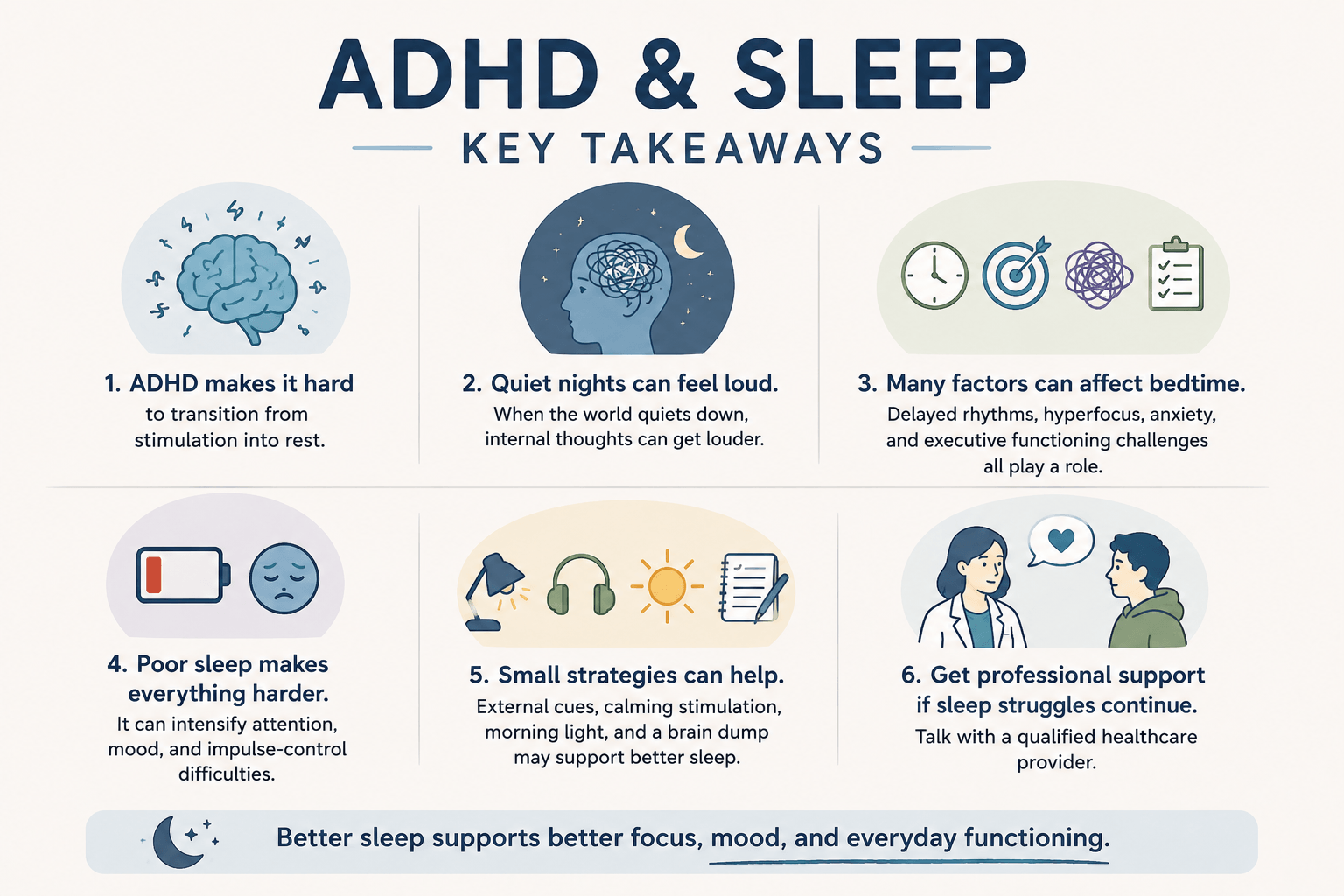
If you have ADHD and want to sleep but your brain won’t stop talking to itself, your mind may be struggling to shift from daytime stimulation into rest. ADHD can affect attention regulation, internal restlessness, time awareness, and sleep rhythms, causing thoughts to feel especially loud when everything becomes quiet at night.
You may feel exhausted throughout the day, only to become wide awake the moment your head hits the pillow.
Suddenly, your mind is replaying conversations, planning tomorrow, remembering unfinished tasks, or exploring ideas that felt completely unimportant an hour earlier.
This experience can be frustrating, but it is not a sign that you are lazy, undisciplined, or doing bedtime wrong. Sleep problems are common among people with ADHD, and research suggests that ADHD and sleep difficulties can influence each other in ways that affect attention, mood, behavior, and daily functioning.
Understanding why your brain becomes active at night can help you build a sleep routine that works with your ADHD brain rather than constantly fighting against it.
Why Does ADHD Make It Hard to Fall Asleep?
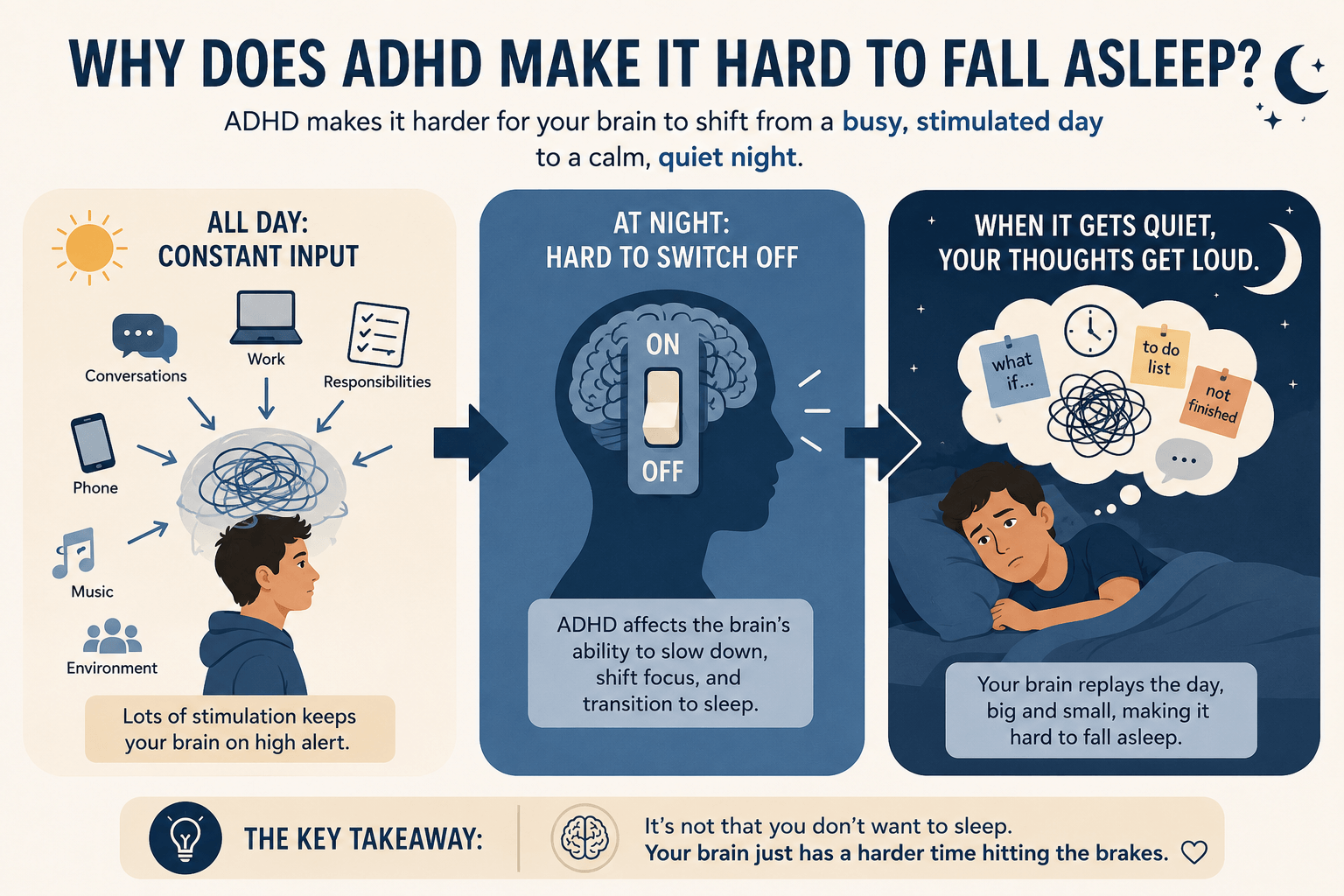
ADHD is commonly associated with difficulty focusing, impulsivity, restlessness, organization, and time management. However, ADHD can also affect the brain’s ability to regulate alertness and transition smoothly between activities.
Going to sleep requires several executive functioning skills:
- Noticing that it is getting late
- Stopping an enjoyable activity
- Moving through a bedtime routine
- Letting go of unfinished tasks
- Shifting attention away from stimulating thoughts
- Allowing the brain and body to settle
Those transitions can be difficult for someone with ADHD.
During the day, your brain receives constant input from work, conversations, responsibilities, music, phones, and the environment. At night, much of that stimulation disappears. When the outside world becomes quiet, your internal thoughts may suddenly become much easier to notice.
This can make it feel as though your brain has been saving every thought from the day until bedtime.
Why Does My ADHD Brain Become More Active at Night?
Many people describe this experience as a “racing brain,” but the thoughts do not always feel fast. Sometimes they feel repetitive, scattered, unusually interesting, or impossible to release.
You might notice your mind:
- Replaying an awkward conversation
- Planning tomorrow in excessive detail
- Jumping rapidly between unrelated ideas
- Remembering tasks you forgot to complete
- Creating imaginary conversations or scenarios
- Becoming intensely interested in a new topic
- Worrying that you will not get enough sleep
The pressure to fall asleep can make the problem worse. Once you begin thinking, “I have to fall asleep right now,” your frustration and alertness may increase.
The bed can gradually become associated with thinking, planning, scrolling, and worrying instead of sleeping.
ADHD, Delayed Sleep, and Your Internal Clock
Your circadian rhythm is the internal clock that helps regulate when you feel alert and when you begin to feel sleepy.
Some people with ADHD experience a delayed sleep pattern, meaning their bodies naturally become tired later at night. They may struggle to fall asleep at a conventional bedtime and have significant difficulty waking in the morning.
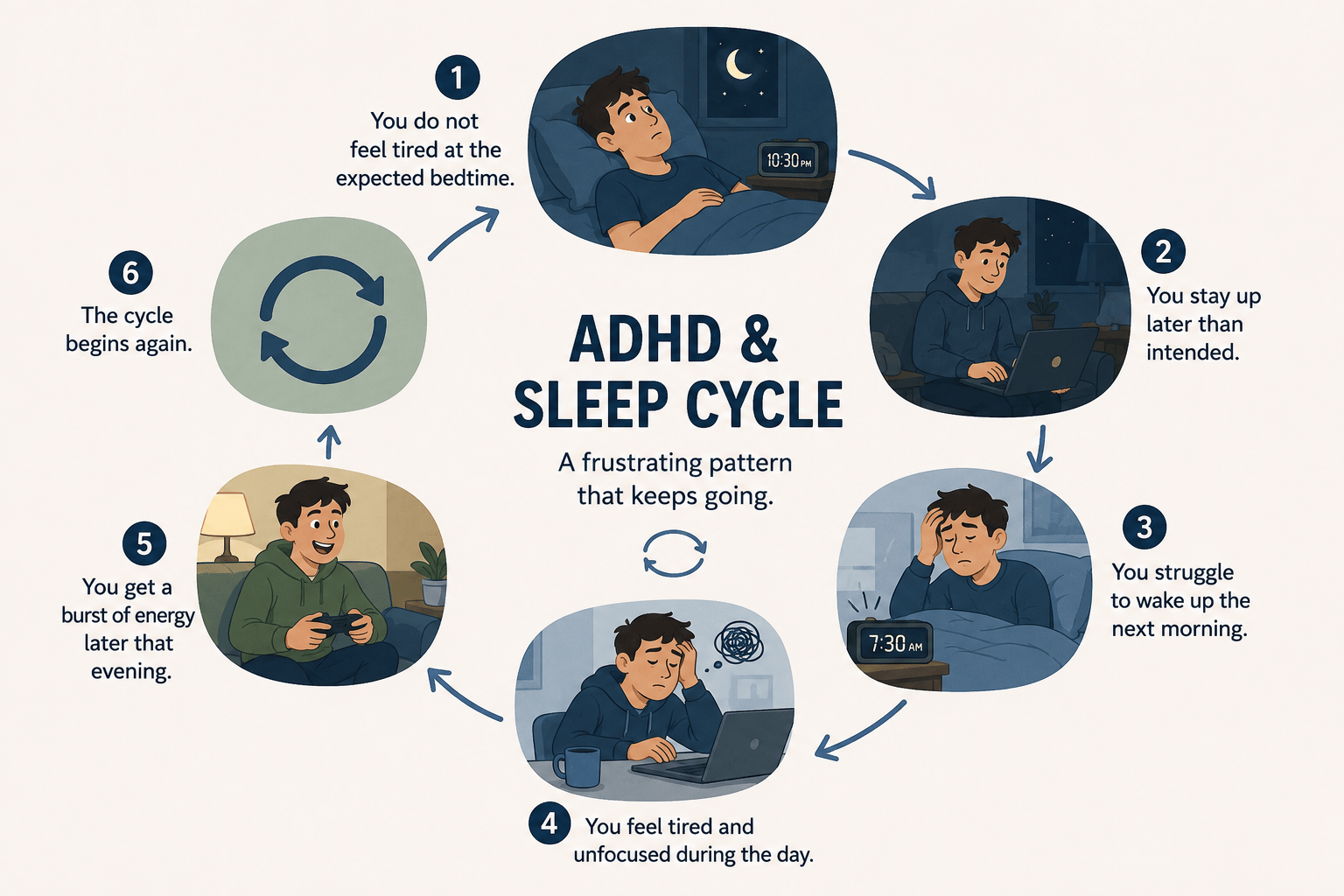
This can create a frustrating pattern:
- You do not feel tired at the expected bedtime.
- You stay up later than intended.
- You struggle to wake up the next morning.
- You feel tired and unfocused during the day.
- You get a burst of energy later that evening.
- The cycle begins again.
This does not mean everyone with ADHD has a delayed circadian rhythm. Sleep apnea, restless legs, anxiety, depression, medication timing, stress, and inconsistent routines can also affect sleep.
However, understanding your natural sleep patterns may help you stop interpreting the problem as a lack of willpower.
How Poor Sleep Can Make ADHD Symptoms Worse
ADHD can make sleep more difficult, and inadequate sleep can make ADHD symptoms more noticeable.
When you are sleep-deprived, you may experience:
- Greater difficulty concentrating
- Increased forgetfulness
- Lower frustration tolerance
- More emotional reactivity
- Reduced motivation
- Greater impulsivity
- Difficulty beginning or completing tasks
These challenges can look very similar to ADHD symptoms. As a result, it may feel as though your ADHD is suddenly getting worse when exhaustion is also contributing to the problem.
Improving sleep will not eliminate ADHD, but more consistent rest may make daily symptoms easier to manage.
Common Reasons People With ADHD Stay Awake
Hyperfocus at Night
You may begin playing a game, researching a topic, watching a show, reading, or completing a project and lose track of time.
Stopping can feel especially difficult when the activity is interesting and bedtime is not.
Revenge Bedtime Procrastination
Sometimes late evening feels like the only part of the day that truly belongs to you.
You may stay awake even though you know you will be tired tomorrow because you want more time without expectations, interruptions, or responsibilities.
Difficulty Transitioning
Knowing you should go to bed and beginning the bedtime process are two different things.
A routine containing several small steps can feel surprisingly demanding when your executive functioning resources are already depleted.
Anxiety or Emotional Overload
ADHD commonly occurs alongside other concerns, including anxiety and depression. The National Institute of Mental Health also notes that sleep problems can co-occur with ADHD and may complicate diagnosis and treatment.
When stress or anxiety is present, quiet nighttime hours may create more space for worries to surface.
Medication Timing
Stimulant medication can affect people differently. Some people notice that medication taken too late interferes with sleep. Others sleep better when medication helps calm mental restlessness during the day.
Do not adjust medication or supplements without speaking with the prescribing medical provider.
How to Quiet an ADHD Brain at Night
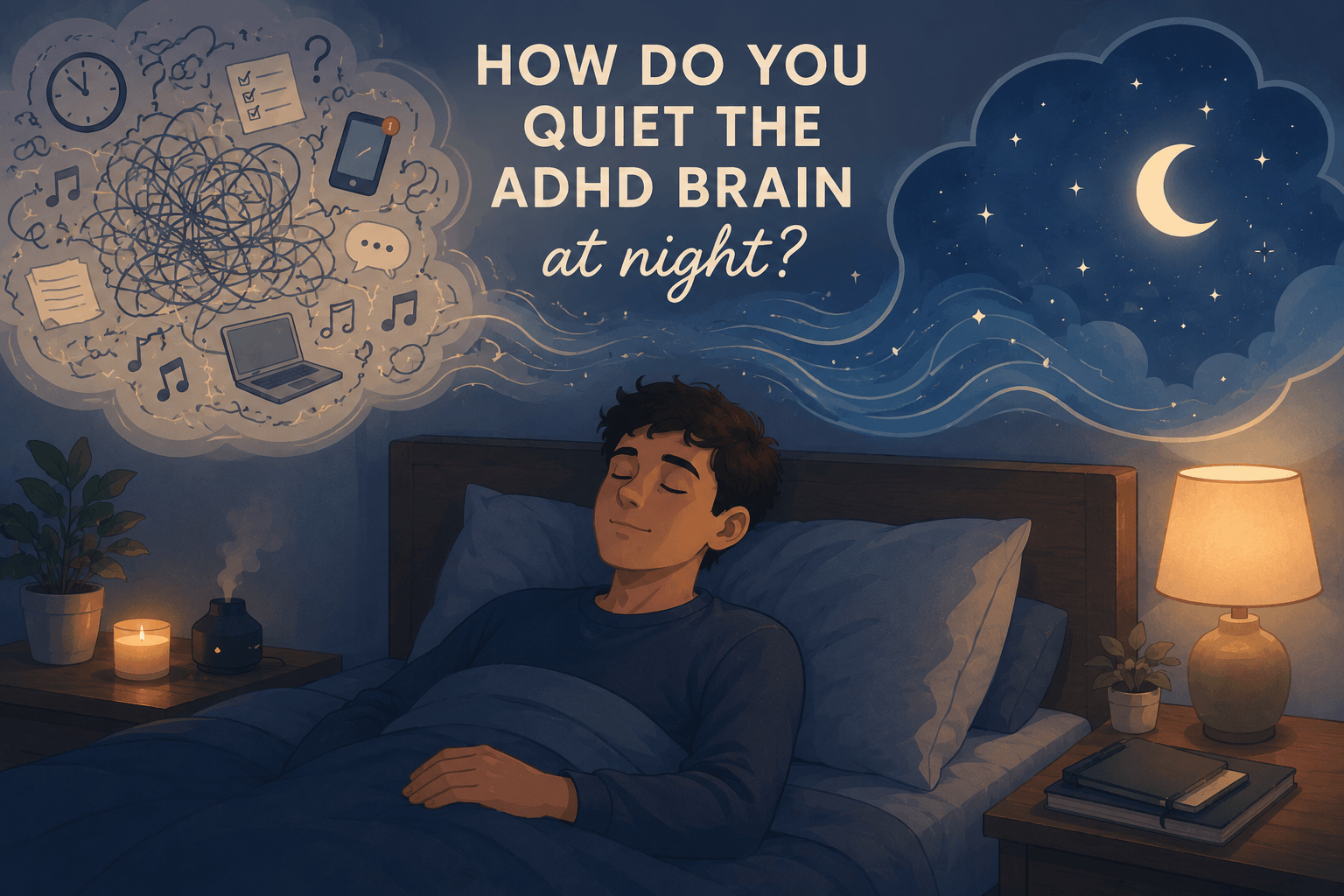
There is no single sleep routine that works for every ADHD brain. Instead of trying to change everything at once, choose one or two strategies and notice what helps.
1. Move Your Thoughts Somewhere Outside Your Brain
Trying not to think about something often makes the thought feel louder.
Keep a notebook, notes app, or voice recorder nearby and create a quick “brain dump” before bed. Write down:
- Tasks you need to remember
- Concerns you want to revisit
- Ideas you do not want to lose
- Plans for tomorrow
- Questions you want to explore later
The goal is not to solve each thought. It is to reassure your brain that the information has been saved.
2. Build a Bedtime Transition, Not Just a Bedtime
A strict command to “go to sleep at 10:30” may not provide enough transition time.
Instead, create a short sequence that signals the day is ending:
- Dim the lights.
- Put away work or stimulating activities.
- Prepare anything needed for tomorrow.
- Choose a calming activity.
- Move to bed when you begin feeling sleepy.
External cues, such as an alarm, smart light, or scheduled phone setting, can help initiate the routine before you become overtired.
3. Choose Calming Stimulation
Many ADHD brains do not relax well with complete silence. The absence of stimulation can sometimes make internal thoughts feel louder.
You might try:
- A familiar audiobook
- A low-key podcast
- White, brown, or pink noise
- Quiet instrumental music
- A guided relaxation exercise
- A simple puzzle or coloring activity before bed
Choose something engaging enough to hold your attention but familiar enough that you do not become more alert.
4. Reduce Decisions Before Bed
A complicated bedtime routine is difficult to repeat consistently.
Prepare as much as possible ahead of time. Keep bedtime items together, charge devices outside the bedroom, lay out morning essentials, and use the same general routine each night.
The fewer decisions your brain has to make, the easier it may be to transition.
5. Use Morning Light to Support Your Sleep Rhythm
Light is one of the strongest signals for the body’s internal clock.
Exposure to outdoor light in the morning can help reinforce wakefulness earlier in the day, which may support sleepiness later that evening. Pairing morning light with a consistent wake time may be more helpful than focusing only on bedtime.
6. Be Intentional About Caffeine and Screens
You do not need to create a perfect screen-free routine overnight.
Begin with a realistic adjustment, such as:
- Moving caffeine earlier in the day
- Reducing screen brightness at night
- Setting a “last scroll” reminder
- Charging your phone away from the bed
- Replacing stimulating content with something familiar
Small, repeatable changes are more helpful than a rigid plan you abandon after two nights.
7. Calm the Body, Not Just the Mind
When your body remains tense or restless, reasoning with your thoughts may not be enough.
Try a body-based strategy such as:
- Progressive muscle relaxation
- Slow breathing with a longer exhale
- Gentle stretching
- A warm bath or shower
- A weighted blanket, when comfortable and appropriate
- Briefly getting out of bed and returning when sleepy
You are not trying to force sleep. You are helping your nervous system receive signals of safety and rest.
What Usually Does Not Help an ADHD Brain Sleep?
Common sleep advice can be helpful, but it often becomes unrealistic when presented as an all-or-nothing rule.
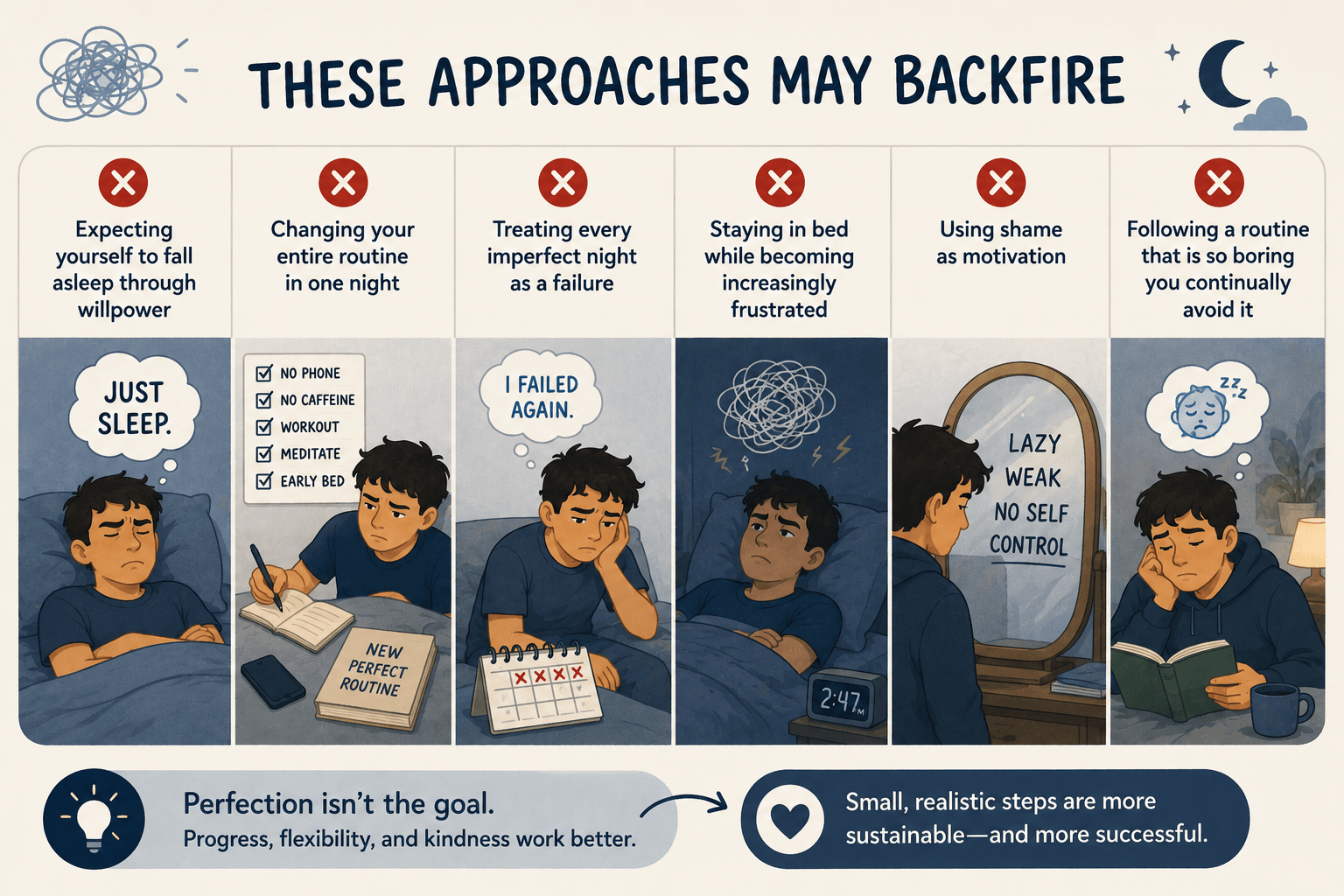
These approaches may backfire:
- Expecting yourself to fall asleep through willpower
- Changing your entire routine in one night
- Treating every imperfect night as a failure
- Staying in bed while becoming increasingly frustrated
- Using shame as motivation
- Following a routine that is so boring you continually avoid it
A successful ADHD sleep routine does not need to look perfect. It needs to be simple enough to begin and flexible enough to repeat.
Approach ADHD Sleep Struggles With Compassion
When you have tried repeatedly to improve your sleep, it is easy to assume you are failing.
You may ask:
“Why can’t I just go to bed like everyone else?”
“Why am I exhausted until it is finally time to sleep?”
“Why do I keep doing this when I know I will regret it tomorrow?”
These questions often create more shame without making sleep easier.
Your brain may need stronger transition cues, different forms of stimulation, support for anxiety, or a routine designed around executive functioning needs. That is not a character flaw. It is information you can use.
Better sleep with ADHD is usually built through experimentation rather than perfection.
When Should You Seek Professional Support?
Consider speaking with a healthcare provider when sleep problems are persistent, significantly affect your daily life, or do not improve with routine changes.
Professional evaluation may be especially important if you experience:
- Loud snoring, gasping, or pauses in breathing
- Uncomfortable sensations or urges to move your legs
- Extreme daytime sleepiness
- Frequent nighttime waking
- Ongoing insomnia
- Significant anxiety or depression
- Sleep changes after beginning or changing medication
A medical provider can evaluate possible sleep disorders, medication effects, and physical factors. A therapist can help you address anxiety, habits, emotional regulation, self-criticism, and executive functioning challenges that may be contributing to bedtime struggles.
Cascade Counseling offers ADHD therapy services for children, teens, and adults who want practical support with attention, routines, emotional regulation, and the everyday challenges of ADHD.