
When Stress Makes Old Patterns Show Up…
The holiday season tends to amplify everything: joy, pressure, expectations, family dynamics, and emotional reactivity. For couples navigating ADHD in the relationship, this time of year can also magnify old patterns, the ones you thought you had outgrown or resolved months ago. The truth is simple and deeply human: when stress rises, we do not rise to the occasion, we fall back on our most familiar patterns.
And ADHD adds layers to those patterns: quicker overwhelm, difficulty regulating emotions, time blindness, social fatigue, forgetting plans or commitments, sensory overload, shame spirals, shutdowns or impulsivity. All of this means that holiday conflict is not a sign that a relationship is broken. It is a sign that the relationship is being asked to carry more weight than usual. The good news is that old patterns do not have to lead to lasting disconnection if couples know how to repair.
This blog post explores why the holidays trigger old cycles in ADHD-impacted relationships and offers clear, compassionate repair tools to help couples reconnect quickly and stay grounded.

Why Holidays Trigger Old Patterns in ADHD Relationships
Before we talk about repair, we have to understand why patterns get activated in the first place. Holidays create the perfect storm.
1. Executive Overload Reawakens Avoidance and Shame Patterns
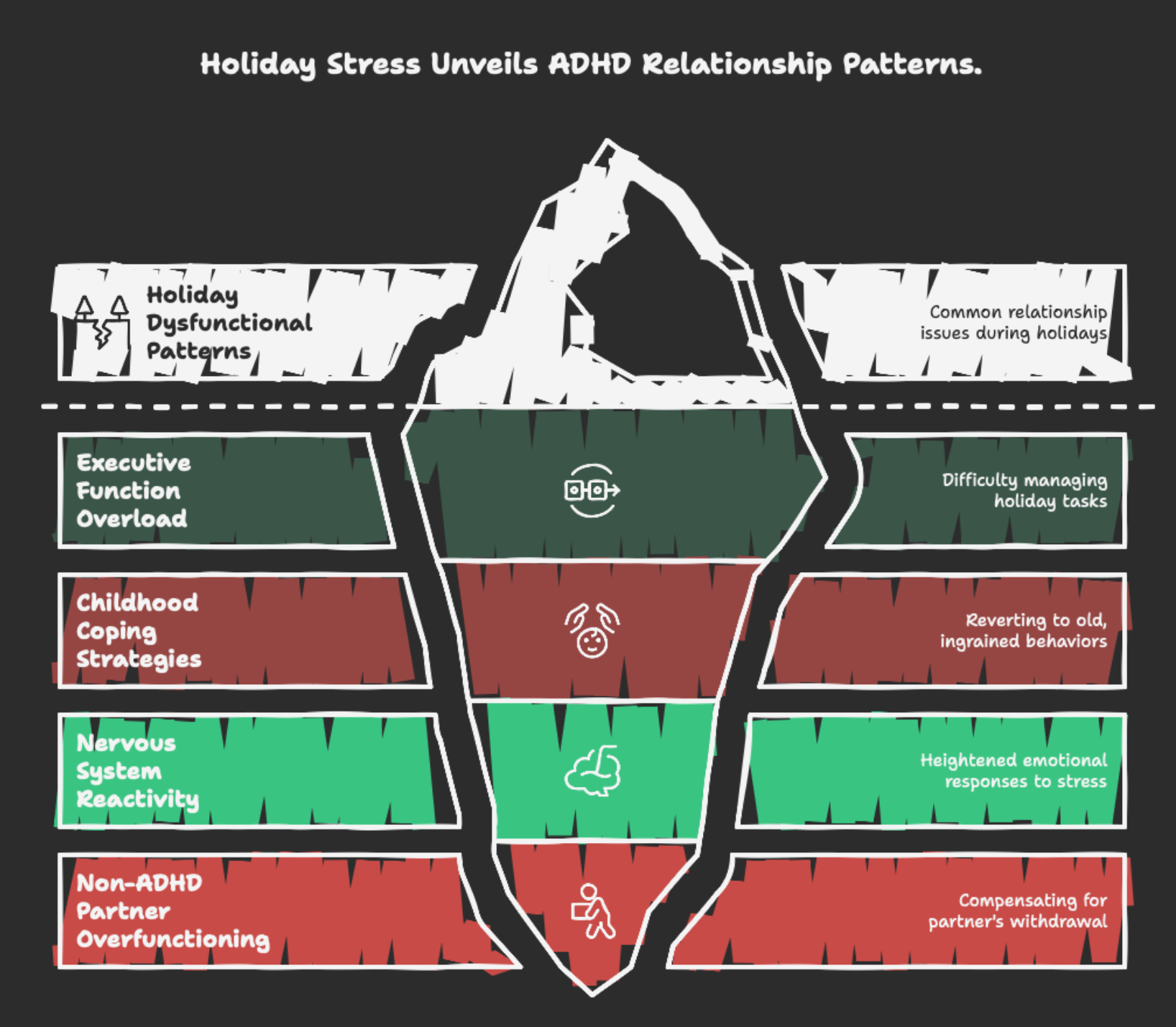
Holiday tasks like gifts, events, travel, and family expectations are executive-function heavy. For ADHD partners, this activates procrastination, forgotten commitments, overwhelm, and avoidance. This often taps directly into shame: “I am disappointing my partner.” “I cannot keep up.” “They are going to be mad at me.” Shame then fuels defensiveness or withdrawal, which mirrors old cycles.
Shame activates a predictable chain reaction: Shame → Fear → Defensiveness → Disconnection → Withdrawal. This is the classic ADHD shame spiral. It happens fast and often outside of awareness. Holiday stress increases demands, social pressure, and emotional intensity, making the spiral even more sensitive to being triggered.
When shame takes over, the ADHD partner might get quiet or shut down, avoid the task or the conversation, get defensive to protect themselves, dismiss the issue to avoid feeling inadequate, lash out when overwhelmed, or retreat into screens or hyperfocus. Meanwhile, the non-ADHD partner often interprets these behaviors as not caring, not trying, doing this on purpose, or “I am alone in this again.” This misinterpretation fuels frustration, criticism, or overfunctioning, which deepens the ADHD partner’s shame and restarts the cycle. Holidays put this cycle on fast-forward.
2. Stress Resurfaces Childhood Coping Strategies
Holidays often involve extended family, childhood homes, old traditions, and family-of-origin dynamics. This can unconsciously activate old wounds and childhood survival strategies such as people-pleasing, perfectionism, shutting down emotionally, anger as protection, or overfunctioning. Couples slip into roles before they realize it.
3. ADHD Makes the Nervous System More Reactive
ADHD brains experience quicker emotional flooding, lower frustration tolerance, stronger fight-flight-freeze responses, and slower return to baseline. This means stress triggers old reactions fast: snapping, withdrawing, shutting down, avoiding conflict, or becoming defensive. What looks like “not caring” is often just nervous system overload. Shutdown is not disinterest, but a system trying to protect itself from more stimulation.
4. The Non-ADHD Partner Often Overfunctions Under Holiday Pressure
When the ADHD partner withdraws or gets overwhelmed, the non-ADHD partner often steps in by controlling the schedule, doing everything, taking on the mental load, making sure everyone else is happy, or tightening expectations. This mirrors old patterns of “I have to do everything myself” or “If I do not, everything falls apart.” Suddenly both partners feel unseen and unsupported.
The Goal Is Not to Avoid Rupture, but to Repair Quickly
Successful couples are not the ones who avoid conflict. They are the ones who know how to come back to each other after conflict. Holiday stress may trigger old wounds, misinterpretations, emotional shutdowns, executive dysfunction, snapping or irritability, misattunement, and feeling alone or misunderstood. Repairing these moments with clarity and compassion is far more important than trying to prevent them entirely.

How to Repair When Stress Activates ADHD Relationship Patterns
These repair tools reflect how both partners can reconnect, restore emotional safety, and come back into secure attachment even when stress has taken over.
1. Pause Before Repair
Use a “pause agreement” such as: “Let’s take 20 minutes to cool down and come back.” “I care about this. I need a break.” “I want to fix this. My brain needs a reset first.” This communicates: I am not abandoning you, I am protecting us, and I am coming back.
2. Use Gentle, Low-Stimulation Openers
When you come back, say things like: “I want us to be okay.” “I am ready if you are.” “That was hard for both of us.” “Let’s slow down and try again.”
3. Own Your Part Without Shame
ADHD partner might say: “I shut down when I got overwhelmed.” “I forgot, but forgetting is not the same as not caring.” Non-ADHD partner might say: “I used a harsh tone.” “I assumed the worst instead of checking in.” Repair grows when responsibility is shared compassionately, not assigned.
4. Validate Each Other’s Internal Experience
Validation lowers defenses. ADHD partner can say: “I get why that felt stressful for you.” Non-ADHD partner can say: “I know that was overwhelming.”
5. Name the Pattern, Not the Person
Instead of “You always do this,” say: “Looks like we fell into that old overwhelm/overfunctioning pattern again.”
6. Repair the Injury Specifically
Specific apologies heal more: “I am sorry I shut down instead of telling you I was overwhelmed.” “I am sorry I made you feel alone with it.”
7. Create a Micro-Plan for Next Time
Pick one small change like: “Next time let’s decide ahead who is doing what.” “Let’s use a shared list.”
8. Close the Repair With Connection
Connection anchors safety. Even a hug, hand squeeze, or “Are we okay?” can reset the moment.
Final Thoughts
Every relationship has patterns. Every couple gets triggered. Every nervous system gets overwhelmed sometimes. Holiday stress does not define the relationship. Repair does. Old patterns do not control you when you come back to each other with clarity, compassion, and teamwork.
If your relationship could use some care, connection, or guidance, we’re here to support you. When you’re ready, reach out and take that next step together.