
When life feels heavy, it’s easy to slip into overdrive: reacting before thinking, withdrawing from people you love, or spiraling into self-criticism. You might tell yourself, “What’s wrong with me?” when you snap at your partner, feel anxious for no reason, or shut down emotionally. But often, these moments aren’t proof that something is wrong with you. They’re signs that your mind and body are running on empty. That’s where the HALTS check-in comes in. It’s a simple yet powerful tool used by mental health professionals and recovery communities to help you pause, identify your needs, and care for yourself before you hit a breaking point.
What Is HALTS?
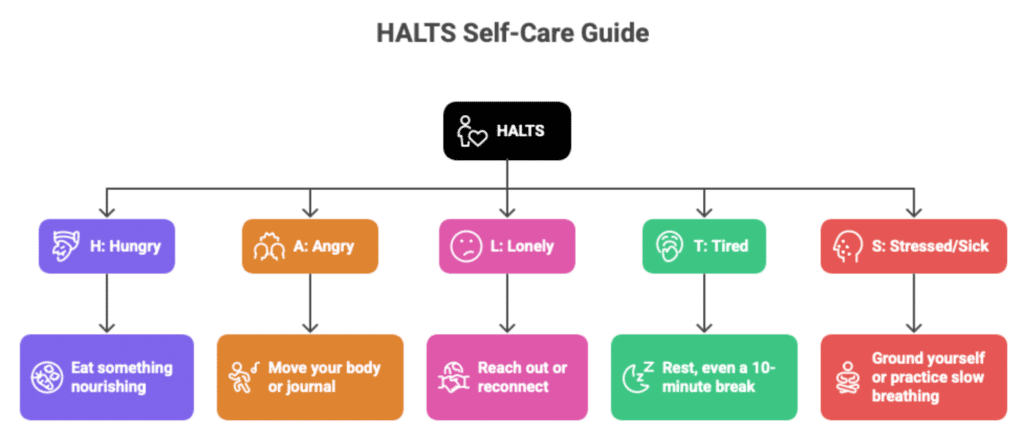
HALTS stands for Hungry, Angry, Lonely, Tired, and Stressed (or Sick). It’s a self-awareness tool that helps you ask one essential question before reacting: “What’s really going on inside me right now?” When emotions start to spiral, HALTS helps you slow down and check for basic unmet needs that might be driving your feelings. This small act of mindfulness can interrupt reactivity and replace shame with understanding.
Featured Snippet Answer (for Search Engines)
The HALTS method is a mindfulness and emotional regulation tool that stands for Hungry, Angry, Lonely, Tired, and Stressed (or Sick). It helps people recognize unmet needs behind emotional reactions so they can respond with care instead of impulsivity.
Why HALTS Works
Emotional regulation begins with awareness. When your body lacks rest, nourishment, or connection, your amygdala (the brain’s emotional alarm system) activates faster, making it harder for the prefrontal cortex (the logic center) to stay in control. By checking in with HALTS, you engage both, calming your body and refocusing your thoughts. This balance creates a bridge between emotion and reason, helping you respond to life instead of reacting to it.
Breaking Down HALTS
H – Hungry
Sometimes, the simplest needs create the biggest emotional waves. Low blood sugar can mimic or magnify anxiety, irritability, or sadness. And “hunger” doesn’t only mean food; it can also mean craving comfort, affection, or stability.
Try this:
-
Eat something balanced, like a protein snack or fruit.
-
Ask yourself, “Am I also hungry for connection or rest?”
-
If emotional hunger feels stronger, reach out to someone who feels safe.
A – Angry
Anger is often misunderstood. It’s not always explosive; sometimes it hides beneath sadness, fear, or guilt. In many cases, anger signals that a boundary has been crossed or a need is being ignored. Instead of judging anger, HALTS helps you see it as information. Ask yourself, “What is my anger trying to protect?”
Try this:
-
Move your body. Walk, stretch, or shake off tension.
-
Journal freely to explore what’s underneath the anger.
-
When calm, reflect: What boundary needs to be set or communicated?
L – Lonely
Human beings are wired for connection, not isolation. But in moments of pain, many people withdraw, convincing themselves they shouldn’t “burden” anyone. Over time, this deepens loneliness and emotional exhaustion. HALTS helps you catch those patterns early.
Try this:
-
Send a message to a friend or family member, even a quick “thinking of you.”
-
Spend time around others, even in small ways such as sitting in a coffee shop or taking a walk.
-
Join a support group or therapy community that reminds you you’re not alone.
Connection is not a luxury. It’s part of how humans heal.
T – Tired
Fatigue is one of the most overlooked triggers for emotional distress. When you’re sleep-deprived or mentally drained, your tolerance for stress drops dramatically. You might notice more irritability, forgetfulness, or negative thoughts. HALTS invites you to pause and ask, “What kind of tired am I?” Sometimes it’s physical exhaustion, but other times it’s emotional or spiritual.
Try this:
-
Give yourself permission to rest without guilt.
-
Unplug from screens for 30 minutes and stretch, nap, or meditate.
-
If you’re emotionally drained, take time for something restorative such as music, journaling, or time in nature.
S – Stressed (or Sick)
Stress isn’t always visible, but it always leaves clues such as muscle tension, headaches, irritability, or racing thoughts. Chronic stress keeps the body in a constant “fight or flight” mode, wearing down your immune system and emotional resilience.
Try this:
-
Ground yourself using your senses: name 5 things you see, 4 you feel, 3 you hear, 2 you smell, 1 you taste.
-
Practice slow breathing: in for 4 seconds, hold for 4, out for 6.
-
If you’re physically unwell, listen to your body. Resting is an act of strength, not weakness.
Why HALTS Matters for Mental Health
When you live with anxiety, depression, trauma, or burnout, your emotions can feel unpredictable. HALTS helps you build emotional literacy by learning to name and understand your feelings instead of fearing them. This small check-in interrupts shame and invites self-compassion. Instead of asking, “What’s wrong with me?” you begin to ask, “What do I need right now?” That question alone can change how you relate to yourself.
How to Make HALTS Part of Your Routine
You don’t need a crisis to use HALTS. It’s just as powerful during calm moments. Here’s how to make it a habit:
-
Build it into your day: Set a reminder on your phone to pause and ask, “Am I Hungry, Angry, Lonely, Tired, or Stressed?”
-
Use it in therapy: Discuss your HALTS check-ins with your therapist to explore triggers and patterns.
-
Journal it: Keep a simple record of which HALTS states show up most often.
-
Share it: Teach HALTS to your partner, children, or friends to foster empathy and connection.
Final Thoughts
Your emotions are not problems to solve. They’re messages asking to be heard. The HALTS method gives you a compassionate pause before the spiral. When you stop and ask, “Am I Hungry, Angry, Lonely, Tired, or Stressed?” you remind yourself that being human isn’t about having it all together. It’s about paying attention to what your body and mind are trying to tell you and responding with care. Take a moment now. Breathe. You might be one check-in away from feeling more grounded than you think.